E-Bike Battery Range: What Affects It and How to Maximize It
Last updated:
6 min read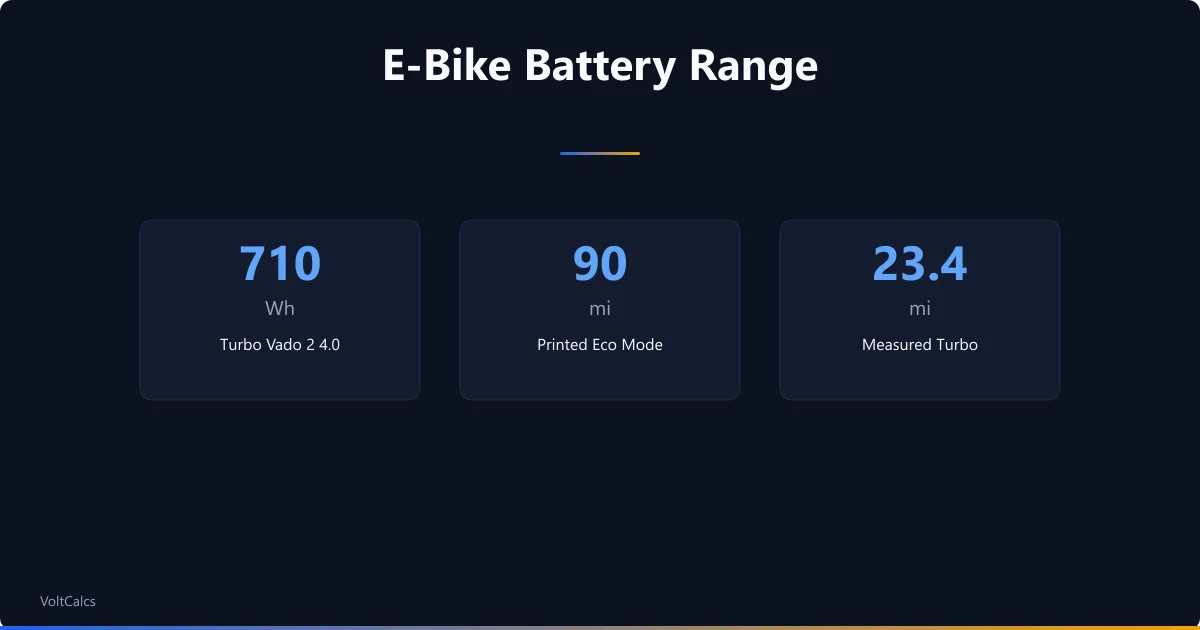
E-bike battery range depends on a handful of measurable variables: battery capacity in watt-hours, assist level, terrain, rider weight, tire pressure, and temperature. A 500Wh battery on a Class 1 pedal-assist bike delivers 25-60 miles depending on how these factors stack up. That range is wide because real riding conditions vary enormously from the flat, windless test tracks where manufacturers get their numbers.
Our e-bike battery range calculator accounts for all of these variables and gives you a realistic estimate for your specific setup. This guide explains why each factor matters and how to push your range toward the higher end.
Battery Capacity: The Starting Point
E-bike range starts with watt-hours (Wh) — not amp-hours, not volts, but the product of both. A 48V 10Ah battery stores 480 Wh. A 36V 14Ah battery stores 504 Wh. The second battery has more energy despite the lower voltage. Always compare batteries by Wh, not by volts or amp-hours alone.
Most mid-range e-bikes ship with 400-625 Wh batteries. Budget commuter models start around 250-360 Wh. Premium long-range bikes offer 700-1,000 Wh. As a rough baseline before factoring in other variables: expect 1 mile per 10-20 Wh of battery capacity, depending on assist level and terrain.
Assist Level: The Biggest Controllable Factor
The pedal-assist level you select has the largest impact on range of any single variable. Most e-bike systems offer 3-5 assist levels that scale how much motor power supplements your pedaling.
| Assist Level | Motor Contribution | Energy Use per Mile | Range on 500Wh Battery |
|---|---|---|---|
| Eco / Level 1 | 30-50% of effort | 8-12 Wh/mi | 42-63 miles |
| Tour / Level 2 | 50-100% of effort | 12-18 Wh/mi | 28-42 miles |
| Sport / Level 3 | 100-200% of effort | 18-25 Wh/mi | 20-28 miles |
| Turbo / Level 4-5 | 200-300% of effort | 25-40 Wh/mi | 13-20 miles |
| Throttle only (no pedaling) | 100% motor | 30-50 Wh/mi | 10-17 miles |
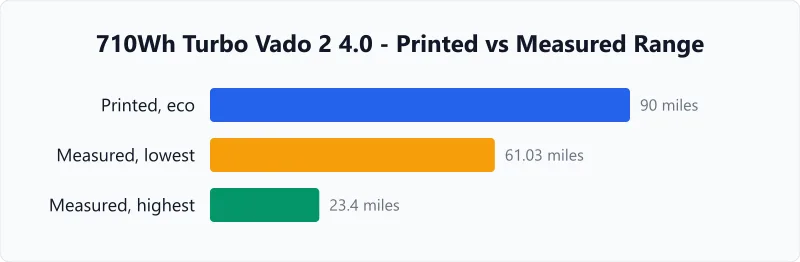
Switching from Turbo to Eco on the same ride is the single biggest change you can make. Electric Bike Report rode a 710Wh Specialized Turbo Vado 2 4.0 to a flat battery twice: 61.03 miles at the lowest assist and 23.42 miles at the highest, 2.6 times the distance. The practical strategy: use Eco for flat stretches and bike paths, bump up to Sport or Turbo only for steep hills and headwinds. Many experienced e-bike commuters ride in Eco 80% of the time and save higher assist for the moments they actually need it.
E-Bike Battery Specifications by Type
Different e-bike categories ship with different battery sizes because their typical use cases demand different range.
| E-Bike Type | Typical Battery | Typical Range (mixed assist) | Primary Use |
|---|---|---|---|
| Commuter / city | 400-500 Wh | 25-50 miles | Daily round-trip under 20 miles |
| Touring / gravel | 500-700 Wh | 40-70 miles | Longer rides, mixed terrain |
| Cargo e-bike | 500-1,000 Wh | 20-50 miles | Heavy loads reduce range |
| Mountain e-bike | 500-750 Wh | 20-40 miles | Steep terrain burns energy fast |
| Folding commuter | 250-400 Wh | 15-35 miles | Last-mile, compact storage |
Notice that cargo and mountain e-bikes get less range from the same battery size. Cargo bikes carry heavy loads that increase rolling resistance and motor demand. Mountain bikes face constant elevation changes and loose terrain where the motor works much harder than on pavement.
Terrain, Temperature, and Rider Weight
Hills are the biggest range killer. Lifting rider and bike up a grade costs energy that flat riding never asks for, and the motor supplies most of it. Nobody publishes a figure for what a given climb costs, because it depends on the grade, your speed and how much of the work you do yourself. Watch the watt-hour readout on a hilly ride and on a flat one: the difference on your own route is the only number worth planning around.
Rider weight directly affects energy consumption. Heavier loads cost energy to accelerate and to climb, and cargo counts the same as body weight. No maker or test body publishes a rule for it; what they publish is the weight their own range figure was measured at. Aventon states 160 lb, and Bosch's battery guide quotes 232 lb total (rider, bike and cargo) for its favourable case and 254 lb for its difficult one.
Cold weather reduces range two ways. Lithium-ion cells give up part of their capacity while they are cold, and cold air and softer tyres cost a little more on top. Both effects are temporary. No figure is published for a given temperature, so treat winter as a season to check your own watt-hour readout rather than to trust a rule of thumb. Storing the battery indoors overnight and installing it just before riding helps preserve capacity in cold weather. The same temperature effects that reduce e-bike range also apply to other battery-powered devices — our drone flight time guide covers how cold affects LiPo cells in a similar way.
Headwind is surprisingly expensive. Aerodynamic drag scales with the square of speed. A 15 mph headwind hitting you at 20 mph ground speed means the air resistance acts as if you are riding 35 mph. At e-bike speeds, wind can reduce range by 10-20% on exposed routes. Tail winds, of course, give you free range back.
Tire pressure matters. Under-inflated tires can cost 5-10% of range through wasted energy absorbed by tire deformation. Check pressure weekly. Most e-bike tires run at 40-65 psi; riding at 35 psi instead of 55 psi is the difference between "feels fine" and a noticeably shorter ride.
A Daily Commuter Scenario
Sarah rides a Rad Power RadCity 5 (672 Wh battery, 48V 14Ah) to work in Portland, Oregon. Her round-trip commute is 16 miles with 400 feet of total elevation gain. She weighs 145 lbs and carries a 10 lb laptop bag.
On the flat bike path sections (10 miles), she uses Eco assist at about 10 Wh/mi: 100 Wh. On the hilly street sections (6 miles with most of the elevation), she bumps to Sport assist at about 22 Wh/mi: 132 Wh. Total daily use: 232 Wh, or about 35% of her 672 Wh battery. She can commute three full days on a single charge with margin to spare.
In January, cold weather and headwind reduce her effective capacity by about 20%. Her daily use climbs to around 280 Wh — still under half the battery. She charges every other day in winter instead of every third day. Knowing these numbers lets her plan confidently rather than watching the battery gauge with anxiety. Run your own commute scenario through the battery runtime calculator with your specific weight, terrain, and battery specs.
How to Maximize Your Range
Use good battery habits. Charge to 80-90% for daily use rather than 100% — this extends long-term battery life without meaningfully reducing daily range. Store the battery between 40-70% if you will not ride for more than a week. Avoid leaving the battery on the charger for days after it reaches full. Lithium-ion cells degrade faster when held at maximum voltage. The concept of depth of discharge applies to e-bike batteries just like it does to larger battery banks — shallower daily cycling means a longer-lasting battery.
Keep your chain lubricated and tires at proper pressure. These mechanical basics cost nothing and protect 5-10% of range that otherwise disappears into friction. Pedal actively in lower assist modes rather than treating the e-bike as a throttle-only vehicle — your legs are free energy that extends battery life. And if your commute is within range on Eco mode, use Eco. Save the higher assist levels for when the road goes uphill or the wind picks up.
If you need to convert between watt-hours and amp-hours when comparing batteries across different voltage platforms, our battery capacity calculator handles the conversion. And if you want to know how long your battery takes to charge from empty, the battery charge time calculator gives you the answer based on your charger rating. If you also ride an electric scooter, the same range principles apply — our electric scooter range calculator accounts for the higher consumption rates and lack of pedal assist.
Frequently Asked Questions
Written and maintained by Dan Dadovic, Commercial Director at Ezoic Inc. & PhD Candidate in Information Sciences. He works professionally as Commercial Director at Ezoic Inc., leading revenue strategy across digital publishing.
Disclaimer: Calculator results are estimates based on theoretical formulas. Actual performance varies with temperature, battery age, load patterns, and equipment condition. For critical electrical work, consult a licensed electrician.
Methodology reviewed by Doc. dr. sc. Damir Topić, Assistant Professor, FERIT Osijek.