Series vs Parallel: How to Configure Your Pack
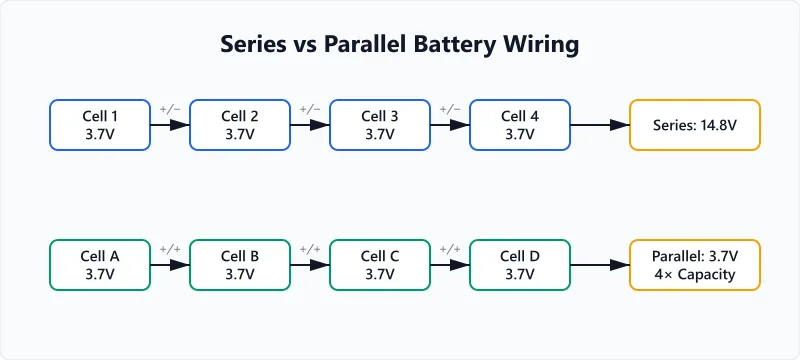
- Series for voltage. Cells wired in series add their voltages. Four 3.2V LiFePO4 cells in series = 12.8V. Eight in series = 25.6V. The capacity stays the same as a single cell. Series is how you build higher-voltage packs: a 48V LiFePO4 pack needs 16 cells in series (16 x 3.2V = 51.2V).
- Parallel for capacity. Cells wired in parallel add their amp-hours. Two 100Ah cells in parallel = 200Ah at the same voltage. Parallel is how you increase runtime without changing voltage.
- Combine both. A "4S2P" configuration means 4 cells in series (for voltage) with 2 parallel groups (for capacity). Four 3.2V 100Ah cells in a 4S2P layout = 12.8V at 200Ah. The total cell count is 4 x 2 = 8 cells.
- Always match cells. Every cell in a pack must be the same chemistry, voltage, capacity, and ideally the same manufacturing batch. Mismatched cells create weak links that reduce pack performance and can be dangerous. Use a BMS (battery management system) to monitor and balance individual cell voltages. If you are building a pack to power a motor, use our HP to watts converter to determine the wattage your pack must deliver.
Common Battery Cells for DIY Packs
| Cell | Chemistry | Nominal V | Capacity | Typical Use |
|---|---|---|---|---|
| EVE LF280K | LiFePO4 | 3.2V | 280Ah | DIY powerwall, solar storage |
| EVE LF105 | LiFePO4 | 3.2V | 105Ah | RV, marine, off-grid |
| CATL 272Ah | LiFePO4 | 3.2V | 272Ah | EV repurpose, powerwall |
| Samsung 30Q | Li-ion (NMC) | 3.6V | 3Ah | E-bike, power tools, EV |
| Samsung 40T | Li-ion (NMC) | 3.6V | 4Ah | High-drain e-bike, EV |
| Sony VTC6 | Li-ion (NMC) | 3.7V | 3.12Ah | E-bike, portable packs |
| Headway 38120S | LiFePO4 | 3.2V | 10Ah | Small solar, RC vehicles |
LiFePO4 prismatic cells (EVE, CATL) are popular for stationary and large mobile builds because of high capacity per cell. 18650/21700 cylindrical cells (Samsung, Sony) are used for e-bikes and portable electronics where weight and size matter more. This is our own estimate; no published source backs these figures. Check your results against your product data or a licensed professional before acting.
Worked Examples
Building a 51.2V LiFePO4 Battery from Prismatic Cells
Context
You want a "48V" LiFePO4 pack for a home solar system. In practice, 48V LiFePO4 packs are built at 51.2V nominal (16 cells × 3.2V). You have 3.2V 100Ah prismatic cells and need 200Ah capacity. How many cells and how are they wired?
Calculation
Series cells for voltage: 51.2V / 3.2V = 16 cells in series
Parallel strings for capacity: 200 Ah / 100 Ah = 2 parallel strings
Total cells: 16 x 2 = 32 cells
Interpretation
32 cells arranged in 16S2P (16 series, 2 parallel). Each cell weighs about 3.2 kg, so the complete pack weighs roughly 102 kg (225 lbs) before the BMS and enclosure. The 51.2V nominal is what the industry calls a "48V" battery — every major manufacturer uses 16S.
Takeaway
After building the pack, size the solar array to recharge it daily with our solar battery charge time calculator — enter 200Ah at 48V with your panel wattage.
Designing a 7S Li-ion E-Bike Pack from 18650 Cells
Context
You want a 25.2V nominal (7S) e-bike battery with 15Ah capacity using Samsung 30Q cells (3.6V nominal, 3Ah each).
Calculation
Series: 7 cells (7 x 3.6V = 25.2V nominal)
Parallel: 15Ah / 3Ah = 5 cells in parallel per series group
Total: 7 x 5 = 35 cells in 7S5P configuration
Energy: 25.2V x 15Ah = 378 Wh
Interpretation
35 cells in a 7S5P pack giving 378 Wh. That is enough for 30-50 km of range on most e-bikes, depending on terrain and assist level. Estimate your range more precisely with the e-bike battery range calculator.
Takeaway
To convert this pack's capacity between Wh and Ah at different voltages, use our Wh to Ah calculator.
Frequently Asked Questions
Glossary
Series Configuration
Connecting cells positive-to-negative in a chain. Each cell adds its voltage while amp-hours stay the same. Four 3.2V 100Ah cells in series = 12.8V 100Ah. Series connections set the pack voltage.
Parallel Configuration
Connecting cells positive-to-positive and negative-to-negative. Each group adds its amp-hours while voltage stays the same. Two 3.2V 100Ah cells in parallel = 3.2V 200Ah. Parallel connections set the pack capacity.
Cell Balancing
The process of equalizing voltage across all series cells in a pack. Without balancing, individual cells drift apart over charge cycles, causing premature capacity loss and potential safety issues. A BMS handles this automatically.
Integrating your custom pack into a solar system? The solar sizing calculator matches panel output to your pack capacity.
Related calculators
Battery Capacity (Amp Hours) Calculator
Calculate battery capacity in amp-hours from watt-hours and voltage. Convert between Wh, Ah, and watts easily.
Battery
Watt Hours to Amp Hours Calculator
Convert watt-hours to amp-hours at any voltage. Use this to compare batteries rated in different units.
Battery
Battery Size for Inverter Calculator
Find the right battery capacity for your inverter. Enter load, runtime, voltage and chemistry: lead-acid banks need more amp-hours than lithium.
Battery
E-Bike Battery Range Calculator
Estimate your e-bike range based on battery size, assist level, terrain, and rider weight. Get instant results for any electric bicycle.
Battery
A custom battery pack gives you exact specs at a lower cost — if you build it correctly. Start with matched cells from the same batch, use a proper BMS, fuse every connection point, and never skip cell-level testing before assembly. The calculator above gives you the cell count and configuration. The rest is careful execution. If you are building a pack for an e-bike, our e-bike battery range guide explains how pack size translates to real-world miles. For electric scooter packs, the scooter range calculator shows how your pack specs translate to miles. For drone-specific builds, the drone flight time guide covers LiPo safety and C-rating requirements.
More Battery calculators
Browse all battery calculators — LiFePO4, lead-acid, AGM, and lithium-ion runtime, charge time, and capacity sizing.
Last updated:
Written and maintained by Dan Dadovic, Commercial Director at Ezoic Inc. & PhD Candidate in Information Sciences. He works professionally as Commercial Director at Ezoic Inc., leading revenue strategy across digital publishing.
Disclaimer: Calculator results are estimates based on theoretical formulas. Actual performance varies with temperature, battery age, load patterns, and equipment condition. For critical electrical work, consult a licensed electrician.
Methodology reviewed by Doc. dr. sc. Damir Topić, Assistant Professor, FERIT Osijek.