Charges by Device Battery Size
Anker publishes the method for this and works an example with it: multiply the bank's capacity by the combined efficiency, then divide by the device battery. Both capacities have to be in the same unit.
| Device battery | Capacity its maker prints | Charges from a 20,000mAh bank |
|---|---|---|
| Anker's own worked-example phone | 3,200mAh | 4.2 charges |
| Samsung Galaxy S24 | 4,000mAh | 3.4 charges |
| Samsung Galaxy S24 Ultra | 5,000mAh | 2.7 charges |
| MacBook Pro 14-inch | 72.4Wh | 0.7 charges |
Every capacity above is printed by the company named in its row. Anker's example runs smaller: a 10,000mAh bank against that 3,200mAh phone gives (10,000 × 0.67) / 3,200 = 2.1 charges, and the same arithmetic against the Galaxy S24's larger battery gives 1.7. Anker's own product pages round that combined figure to 0.65 in places, which takes about 3% off every count above. Where a battery is quoted in mAh the comparison assumes both packs sit at a similar cell voltage, which is how Anker works its own example. Your own count lands lower on a cold day or through a thin cable.
How to Find Your Power Bank's Real Capacity
- Find the mAh rating on the label. This is the cell-level capacity at the internal voltage (usually 3.7V). A "20,000mAh" bank stores 74Wh (20,000 x 3.7 / 1000).
- Check for a Wh rating. Some manufacturers list the real energy in watt-hours. This is a more honest spec. Airlines require Wh for lithium battery limits (100Wh carry-on, 160Wh with airline approval).
- Apply the conversion loss. Anker prints about 82% efficiency for the step out of the bank, so a 74Wh pack delivers about 61Wh at the USB port. The rest leaves as heat.
- Divide by your device battery, in the same unit. Anker's published example divides mAh by mAh: (10,000mAh × 0.67) / 3,200mAh = 2.1 charges. The 0.67 is the two conversions multiplied together, one in the bank and one in the phone.
Worked Examples
How Many Phone Charges from a 20,000mAh Power Bank?
Context
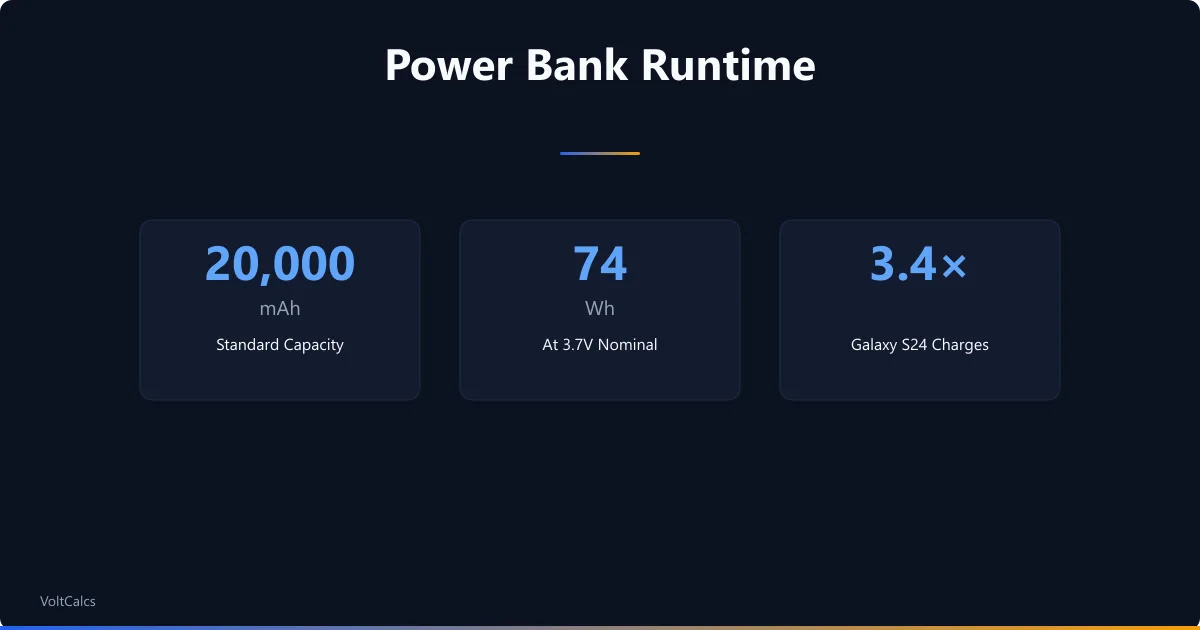
Your power bank is rated 20,000 mAh at 3.7V. The phone is a Galaxy S24, which Samsung rates at 4,000 mAh. You want the real number of full charges.
Calculation
Combined efficiency: 0.82 x 0.82 = 0.67, the two conversion steps Anker prints
Charges: (20,000 x 0.67) / 4,000 = 3.4
Energy side: 20,000 x 3.7 / 1,000 = 74 Wh; 74 x 0.82 = 60.7 Wh usable, which the tile rounds to 61
Interpretation
You get about three and a half charges, not the five you would get by dividing 20,000 by 4,000. Two conversion steps take the difference, one inside the bank and one inside the phone.
Takeaway
For longer trips where you need to track total energy across power banks and batteries, convert everything to watt-hours using our Wh to Ah calculator.
Running a USB-C Laptop from a Power Bank
Context
Your laptop draws 45W over USB-C. You have a 20,000 mAh / 74 Wh power bank. How long will it hold the laptop up?
Calculation
Usable energy: 74 x 0.82 = 60.7 Wh
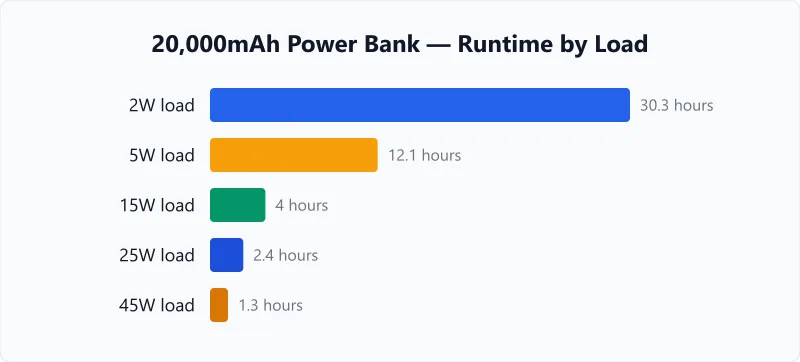
Runtime: 60.7 / 45 = 1.3 hours
Interpretation
About 1 hour and 21 minutes of active laptop use. The charge-count tile hides itself at this load: 45W is past the 25W Samsung prints for the Galaxy S24, so counting phone charges would say nothing useful about a laptop.
Takeaway
For all-day laptop power off-grid, you need a proper battery bank, not a USB power bank. Check our laptop battery runtime calculator to find the right capacity for your usage pattern.
Frequently Asked Questions
Glossary
Milliampere-Hours
A unit of charge capacity equal to 1/1000 of an amp-hour. Power banks use mAh ratings because the numbers sound larger — 20,000 mAh is more marketable than 20 Ah, even though they are the same capacity.
Conversion Efficiency
The share of stored energy that survives the step-up to the USB output. Anker prints about 82% for that step and the same again inside the device, so roughly 67% of the energy in the cells reaches a phone battery. That is the gap between the mAh on the label and the charges you actually get.
Voltage Boost
The converter that lifts the pack's cell voltage up to the voltage the USB output has to supply. Every boost costs energy as heat, which is where the 82% figure comes from. Higher output voltages need more boost, so a laptop-class port is not free either.
Curious how long a solar panel takes to refill your power bank? Check the solar battery charge time calculator.
Related calculators
Laptop Battery Runtime Calculator
Estimate your laptop battery life based on battery Wh rating and actual power consumption by usage mode.
Battery
CPAP Battery Runtime Calculator
Calculate how many nights your battery powers a CPAP machine. Enter battery capacity, voltage, and CPAP wattage for instant runtime results.
Battery
Watt Hours to Amp Hours Calculator
Convert watt-hours to amp-hours at any voltage. Use this to compare batteries rated in different units.
Battery
How Many Watts in a 12V Battery?
Calculate total watt-hours stored in any 12V battery from its amp-hour rating. Includes common 12V battery examples.
Battery
Power bank marketing quotes cell-level mAh, which is why the headline number never survives the trip to your device. Anker's own product page puts the end-to-end loss at 30% to 45% of rated capacity, so expect 55% to 70% of the headline mAh to reach whatever you are charging. Convert to watt-hours for any honest comparison between packs. For larger portable batteries used on e-bikes, the same Wh-based math applies — see our e-bike battery range calculator for range estimates that factor in terrain and assist level.
More Battery calculators
Browse all battery calculators — LiFePO4, lead-acid, AGM, and lithium-ion runtime, charge time, and capacity sizing.
Last updated:
Written and maintained by Dan Dadovic, Commercial Director at Ezoic Inc. & PhD Candidate in Information Sciences. He works professionally as Commercial Director at Ezoic Inc., leading revenue strategy across digital publishing.
Disclaimer: Calculator results are estimates based on theoretical formulas. Actual performance varies with temperature, battery age, load patterns, and equipment condition. For critical electrical work, consult a licensed electrician.
Methodology reviewed by Doc. dr. sc. Damir Topić, Assistant Professor, FERIT Osijek.