Drone Battery Flight Time: Why Real Numbers Are Lower
Last updated:
7 min read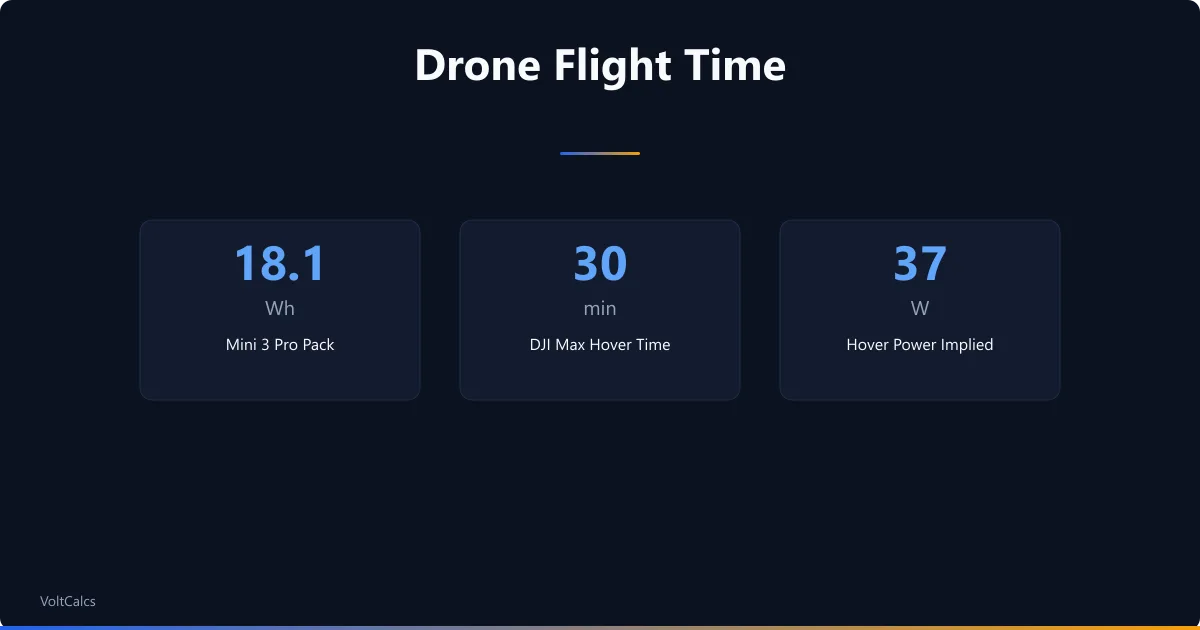
Drone flight time as printed on the box is a best-case number. Manufacturers test with no payload, no wind, at a steady hover in ideal temperature. Your real flights involve camera gimbals, accessories, wind resistance, aggressive maneuvers, and batteries that are no longer brand new. The gap between the printed figure and your flight is the reserve you land on, plus whatever wind, climbing and payload add to your average power.
Our drone battery flight time calculator accounts for these real-world factors and gives you a number you can actually plan around. This guide explains why that gap exists and how to get the most out of every charge.
What DJI Prints, and the Power It Implies
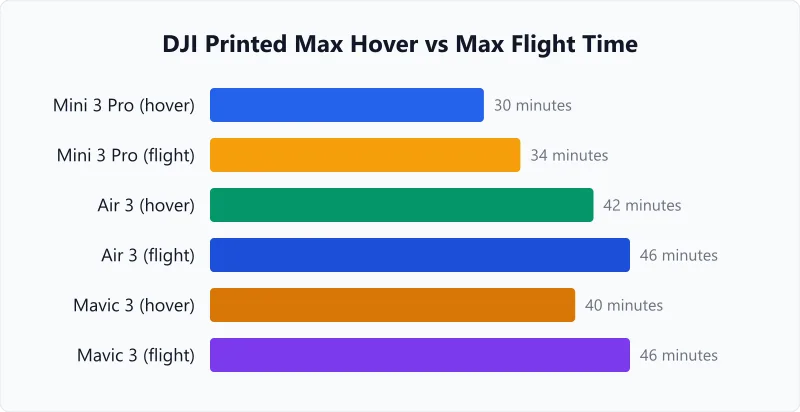
DJI publishes two flight figures for each aircraft alongside the pack energy behind them. Dividing the energy by each time gives the average power that figure assumes.
| Drone Model | Pack DJI prints | Max hovering time (no wind) | Max flight time (no wind) | Power the hover figure implies | Power the flight figure implies |
|---|---|---|---|---|---|
| DJI Mini 3 Pro | 2,453mAh, 7.38V, 18.1Wh | 30 min | 34 min | 37W | 32W |
| DJI Mini 4 Pro | 2,590mAh, 7.32V, 18.96Wh | 30 min | 34 min | 38W | 34W |
| DJI Air 3 | 4,241mAh, 14.76V, 62.6Wh | 42 min | 46 min | 90W | 82W |
| DJI Mavic 3 | 5,000mAh, 15.4V, 77Wh | 40 min | 46 min | 116W | 101W |
| DJI FPV | 2,000mAh, 22.2V, 44.4Wh | 16 min | 20 min | 167W | 134W |
The DJI FPV is the power-hungry one on that list. Holding position costs it 167W against the Mini 3 Pro's 37W, more than four times the power for a pack with about two and a half times the energy, which is why its hovering figure is 16 minutes and the Mini's is 30. Plan against the hover column, the more conservative of the two, and subtract the reserve you intend to land on rather than a blanket percentage.
Why Advertised Numbers Are Too High
Manufacturer testing conditions diverge from real flying in five specific ways.
No payload. A bare drone without a camera or gimbal weighs less. Even on drones where the camera is "included," test conditions may remove accessories, prop guards, or aftermarket additions that add 50-200g. Every gram costs energy to keep airborne.
No wind. Factory tests happen indoors or in dead-calm conditions. Real flights face wind. Even a gentle breeze forces the motors to tilt and thrust continuously to hold position, so they work harder than in a calm hover and the flight ends sooner. Gusty conditions are worse because the flight controller makes rapid corrections that spike current draw.
Perfect temperature. LiPo batteries give up part of their capacity when they are cold, so expect less flight time near freezing and warm the pack before takeoff. Manufacturer specs do not account for your local January morning.
Steady flight only. Climbing, sprinting, rapid acceleration and fighting a headwind all demand more power than a stationary hover. Steady forward flight is a different case: DJI rates its FPV at 20 minutes flying at a steady 40 kph in still air against 16 minutes hovering, so moderate forward flight can cost less than holding still.
Brand new battery. Test batteries have zero cycles on them. DJI's support article counts one battery cycle each time 75% of the rated capacity in the official manual is consumed, and says performance naturally declines as the cycle count rises. Capacity fades with cycles, and a pack that once flew the full 34 minutes will not do it forever. DJI publishes no per-cycle capacity curve for these packs, so track your own: log the minutes each pack delivers and retire it when the trend stops being acceptable. This capacity fade follows the same depth of discharge principles that govern all lithium batteries - deeper discharges accelerate degradation.
The Physics of Hovering: Where the Energy Goes
A multirotor drone stays airborne by pushing air downward with its propellers. The energy required to hover is governed by a simple relationship tied to the same power-and-energy math behind all battery runtime estimates: heavier drones and smaller propellers need more power. DJI's sub-249g Mini-class Mini 3 Pro hovers for a printed 30 minutes on an 18.1 Wh pack, while its 4S Air 3 needs 62.6 Wh, more than three times the energy, for 42 minutes.
Hover power scales roughly with the 1.5 power of weight. Doubling the weight of a drone does not double the power needed to hover - it roughly triples it (2^1.5 = 2.83). This is why payload weight has such a dramatic effect on flight time: every accessory you add raises hover power by more than its share of the weight.
Propeller efficiency also matters. Larger, slower-spinning props are more efficient at generating thrust than smaller, faster ones. This is why long-endurance drones use oversized propellers relative to their frame size, and why FPV racing quads (small aggressive props) burn through batteries at astonishing rates.
Planning a Photography Mission
Marcus shoots real estate aerial photography in Austin, Texas. He flies a DJI Mavic 3 Pro with a full camera payload. A typical property shoot involves 15-20 minutes of active flying: establishing shots at 200-400 feet, slow orbits around the property, and several stationary hovers for bracket exposures.
He plans each battery from DJI's printed hover time rather than the longer flight figure, sets aside time for takeoff and landing, and keeps a mandatory 20% reserve (required by his own safety protocol - landing with the battery warning flashing is unprofessional and risky). What is left is his productive shooting time per battery. He carries 4 batteries per shoot session and plans for 3 usable flights: one battery always stays as an emergency spare.
On windy days his flight time per battery drops, and his usable window shrinks with it. He adjusts his shot list accordingly - fewer orbits, stationary holds kept to the bracket exposures that need them (holding position still costs power, and DJI rates its FPV at 20 minutes in steady forward flight against 16 minutes hovering, so moderate forward flight can cost less), and tighter framing that requires less repositioning. He runs his plan through the battery runtime calculator before each shoot to confirm his plan works.
LiPo Battery Care and Longevity
LiPo batteries are the standard for drones because of their high energy density and ability to deliver massive current bursts. They are also fragile and demand more careful handling than the lithium-ion cells in your phone or e-bike.
Storage voltage matters. Store LiPo batteries at 3.8V per cell (about 50% charge) if you will not fly for more than a few days. Leaving batteries fully charged for weeks degrades cell chemistry and reduces lifespan. Most modern drone chargers have a "storage mode" that discharges or charges to the optimal storage voltage automatically. Use it. Battery University recommends partial charge storage for all lithium-based cells.
Do not discharge below 20% in flight. LiPo cells suffer permanent damage when voltage drops too low. Most drone flight controllers trigger a Return-to-Home when the battery runs low for good reason. Fighting the RTH warning to squeeze out an extra 2 minutes of flying risks a battery that delivers less capacity on every subsequent flight - a bad trade.
Temperature management. Never charge a LiPo that is hot from a flight. Let it cool to room temperature first (15-20 minutes). Charging a hot LiPo accelerates chemical degradation. In cold weather, keep batteries in an inside jacket pocket until just before takeoff — starting at a reasonable temperature gives you the full capacity. If you are building custom battery packs for larger drones, our battery pack calculator helps you design the right configuration. E-bike riders face similar cold-weather range loss — see our e-bike range guide for strategies that apply to any lithium-powered vehicle.
Track your cycles. Label each battery with a number and keep a simple flight log: date, flight time, minimum cell voltage reached. When a battery consistently delivers clearly less flight time than when it was new, replace it. Flying on worn batteries that might fail mid-flight is not worth the risk to your aircraft or the people below it. Use the Wh-to-Ah calculator to compare different battery options when shopping for replacements.
Frequently Asked Questions
Written and maintained by Dan Dadovic, Commercial Director at Ezoic Inc. & PhD Candidate in Information Sciences. He works professionally as Commercial Director at Ezoic Inc., leading revenue strategy across digital publishing.
Disclaimer: Calculator results are estimates based on theoretical formulas. Actual performance varies with temperature, battery age, load patterns, and equipment condition. For critical electrical work, consult a licensed electrician.
Methodology reviewed by Doc. dr. sc. Damir Topić, Assistant Professor, FERIT Osijek.