Using a 12V Battery for Your Fridge During a Power Outage
Last updated:
8 min read
A 12V battery backup for your fridge is the most practical way to keep food safe during a power outage. Food spoils after 4 hours without power according to the FDA if the door stays closed. A 12V battery with an inverter can keep your fridge running for 6-24+ hours depending on the battery size and fridge model.
This guide covers what you need, how to set it up, and how long different battery sizes will actually last with real fridge power data.
How Much Power Does a Fridge Actually Use?
Refrigerators do not draw constant power. The compressor cycles on and off — running for 10-20 minutes, then shutting off for 20-40 minutes. The wattage printed on the nameplate (typically 100-200W) is the compressor's running draw. Average consumption over a full day is much lower because the compressor only runs 30-40% of the time.
| Fridge Type | Compressor Watts | Average Watts | Daily kWh |
|---|---|---|---|
| Mini fridge (1.5-4.5 cu ft) | 60-80W | 25-35W | 0.6-0.8 |
| Standard top-freezer (14-18 cu ft) | 100-150W | 40-60W | 1.0-1.5 |
| Standard bottom-freezer (18-22 cu ft) | 120-180W | 50-70W | 1.2-1.7 |
| Side-by-side (22-26 cu ft) | 150-200W | 60-90W | 1.4-2.2 |
| French door (22-28 cu ft) | 150-250W | 70-100W | 1.7-2.4 |
| Chest freezer (standalone) | 60-100W | 30-50W | 0.7-1.2 |
| 12V DC compressor fridge (RV/marine) | 40-80W | 25-45W | 0.6-1.1 |
The average wattage column is what matters for battery runtime calculations. A standard top-freezer refrigerator averages about 50W — not 150W. Using the compressor wattage instead of the average gives you a runtime estimate that is 60-70% shorter than reality.
To measure your specific fridge, plug a kilowatt-hour meter (like a Kill A Watt) into the wall outlet and run it for 24 hours. Divide the kWh reading by 24 to get average watts. This gives you the most accurate number for battery sizing. Alternatively, check the yellow EnergyGuide label on your fridge — it lists annual kWh, which you can divide by 365 to get daily kWh, then by 24 for average watts.
Choosing the Right Battery
For a power outage fridge backup, you need a deep cycle battery — not a car starting battery. Starting batteries deliver high current for a few seconds (engine cranking) but are not designed for sustained discharge. Deep cycle batteries deliver moderate current for hours, which is exactly what a fridge needs.
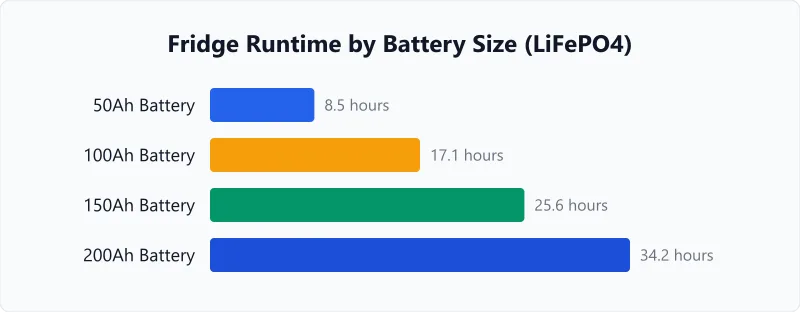
LiFePO4 is the best choice for dedicated fridge backup. At 80% depth of discharge, a single 100Ah 12V LiFePO4 battery provides about 864Wh of usable energy (after inverter losses). That powers a standard fridge averaging 50W for roughly 17 hours — use the battery runtime formula to verify the math for your specific fridge. Two batteries extend that to 34+ hours — covering even a multi-day outage.
Lead-acid/AGM works but delivers less runtime per battery. At 50% DoD, a 100Ah 12V lead-acid battery provides about 540Wh usable (after inverter losses). That is roughly 11 hours on a 50W average fridge load. You need nearly double the lead-acid capacity to match LiFePO4 runtime. For a detailed comparison, see our LiFePO4 vs lead-acid guide.
Use the 12V battery fridge calculator to see exact runtime for your battery size and fridge wattage.
Sizing the battery for your specific fridge
To calculate the exact battery capacity you need, start with your fridge's average wattage (from the EnergyGuide label or a Kill A Watt meter). Multiply by the hours of backup you want, then account for inverter losses and depth of discharge.
For example: a standard top-freezer fridge averaging 55W, with 24 hours of desired backup, through a 90%-efficient inverter, on a LiFePO4 battery at 80% DoD:
Required capacity = (55W × 24h) / (0.90 efficiency × 12V × 0.80 DoD) = 1,320 / 8.64 = 153 Ah
A 200Ah LiFePO4 battery gives you comfortable margin above the minimum. For a larger French door fridge averaging 80W with the same 24-hour target: (80 × 24) / (0.90 × 12 × 0.80) = 222 Ah. That pushes you to either a single 300Ah battery or two 200Ah batteries in parallel.
If your target is shorter — 8-12 hours to bridge a typical outage — a single 100Ah LiFePO4 battery handles most standard fridges comfortably. The key is knowing your fridge's actual average consumption, not the nameplate compressor wattage. The gap between the two is often 60-70%, and using the wrong number leads to either an oversized battery you did not need or an undersized one that runs out mid-outage.
Setting Up a Battery Backup for Your Fridge
A basic fridge backup system has three components: battery, inverter, and cables.
- Battery. A 100Ah 12V LiFePO4 battery provides 14-18 hours of fridge runtime. For 24+ hours, use 200Ah or two 100Ah batteries in parallel. Keep the battery in a ventilated area (not required for LiFePO4 but good practice) near the fridge location to minimize cable length.
- Inverter. A refrigerator requires a pure sine wave inverter — modified sine wave inverters can damage compressor motors and cause humming or overheating. Size the inverter for the compressor startup surge, not average draw. A fridge with a 150W running draw has a startup surge of 600-1,200W lasting about 1 second. A 1,000-1,500W pure sine wave inverter handles any standard household fridge. Do not oversize — a 3,000W inverter running a 50W average load wastes energy on standby consumption.
- Cables. Use appropriately sized cables between the battery and inverter. For a 1,000W inverter on a 12V battery, peak current draw is about 90A (during fridge compressor startup). This requires 4 AWG cable for runs up to 3 feet, or 2 AWG for up to 6 feet. Undersized cables cause voltage drop that reduces inverter efficiency and can overheat. Size your cables correctly with the inverter cable sizing calculator.
- Connection. Connect battery to inverter with properly crimped or soldered ring terminals. Plug the fridge into the inverter's AC outlet. The fridge does not know or care that it is running on battery — it sees standard 120V AC power from the inverter, same as the wall outlet.
- Recharging. After the outage, recharge the battery using a compatible smart charger from a wall outlet. LiFePO4 batteries need a charger with a LiFePO4 setting. A 20A charger restores a 100Ah battery in about 5 hours — model your exact recharge time with the battery charge and discharge calculator. If outages are frequent, consider adding a solar panel for daytime recharging — even a 100W panel provides meaningful supplemental charge during the day.
Runtime Estimates by Battery Size
These estimates use a typical standard top-freezer fridge averaging 50W, with a pure sine wave inverter at 90% efficiency and LiFePO4 batteries at 80% DoD.
| Battery Setup | Usable Energy | Estimated Runtime (50W avg fridge) |
|---|---|---|
| 50Ah 12V LiFePO4 | 432 Wh | ~8.5 hours |
| 100Ah 12V LiFePO4 | 864 Wh | ~17 hours |
| 200Ah 12V LiFePO4 | 1,728 Wh | ~34 hours |
| 300Ah 12V LiFePO4 | 2,592 Wh | ~52 hours (2+ days) |
| 100Ah 12V Lead-Acid (50% DoD) | 540 Wh | ~11 hours |
| 200Ah 12V Lead-Acid (50% DoD) | 1,080 Wh | ~22 hours |
For a larger fridge (side-by-side or French door averaging 75-90W), reduce these runtimes by 35-45%. A 100Ah LiFePO4 battery running a 75W-average French door fridge lasts about 11.5 hours instead of 17.
Extending Your Backup Runtime
Keep the fridge door closed. Every time you open the door, cold air escapes and the compressor must run longer to recover. During an outage, limit door openings to once every 2-3 hours. A closed fridge holds safe temperatures (below 40°F) for about 4 hours even without power. A closed freezer holds safe temperatures for 24-48 hours if full.
Turn off the ice maker. Automatic ice makers draw extra power and are unnecessary during an outage. Disconnect or disable them to reduce the fridge's average consumption by 10-20%.
Set the fridge to a slightly warmer temperature. If your fridge is normally set to 35°F, bumping it to 38-39°F (still safe per FDA guidelines) reduces compressor run time and extends battery life by 10-15%.
Pre-chill before the outage. If you have warning (hurricane forecast, planned utility maintenance), set the fridge to its coldest setting 24 hours in advance and fill any empty space with water bottles. The thermal mass of cold food and water keeps the fridge colder longer, reducing compressor run cycles once you switch to battery power.
Consider a dedicated 12V DC fridge. A 12V DC compressor fridge (like those used in RVs and boats) connects directly to the battery without an inverter, eliminating the 10-15% inverter efficiency loss. For a dedicated emergency backup, a small 12V fridge running directly from a battery bank is the most efficient option. Use the battery runtime calculator to compare DC vs AC fridge runtime on the same battery.
Add a small solar panel. A single 100-200W solar panel connected to a charge controller can add 400-1,000 Wh of charge per day — enough to partially offset fridge consumption and extend your backup by 1-2 days. During a multi-day outage with even partial sunshine, solar recharging can keep a well-sized battery bank running indefinitely. Calculate your panel needs with the solar battery charge time calculator.
Combine with a generator for extended outages. For multi-day blackouts, a battery bank paired with a small propane generator covers you around the clock — charge the battery during the day, run the fridge on battery overnight. Our propane generator runtime guide explains fuel planning and runtime estimates for this hybrid approach.
Frequently Asked Questions
Written and maintained by Dan Dadovic, Commercial Director at Ezoic Inc. & PhD Candidate in Information Sciences. He works professionally as Commercial Director at Ezoic Inc., leading revenue strategy across digital publishing.
Disclaimer: Calculator results are estimates based on theoretical formulas. Actual performance varies with temperature, battery age, load patterns, and equipment condition. For critical electrical work, consult a licensed electrician.
Methodology reviewed by Doc. dr. sc. Damir Topić, Assistant Professor, FERIT Osijek.