Why Solar Time Differs from Clock Time
Clock time is a political convenience. Time zones cover 15 degrees of longitude each, but everyone within a zone uses the same clock. If you live on the eastern edge of a time zone, solar noon arrives before 12:00 PM. On the western edge, it arrives after. The difference can be up to 30 minutes just from your position within the time zone.
On top of that, Earth's orbit is elliptical, not circular. This means Earth's orbital speed varies throughout the year — faster near perihelion (January) and slower near aphelion (July). The tilt of Earth's axis adds another wrinkle. Together, these effects create the Equation of Time: a correction factor that swings solar noon by up to 16 minutes ahead or behind clock noon depending on the date.
Daylight saving time adds a third offset. During DST, solar noon shifts an additional hour later on the clock. In some western-edge-of-timezone locations during DST, solar noon does not occur until nearly 1:45 PM.
Example: Finding Solar Noon in Denver, Colorado
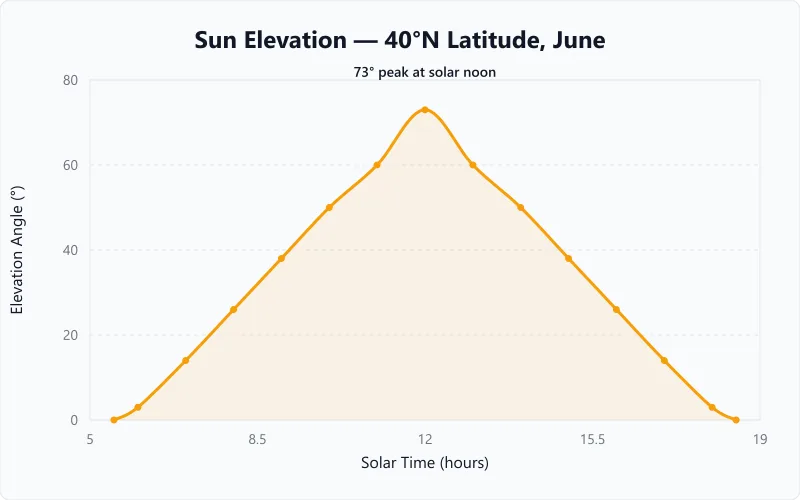
Denver sits at longitude -104.99°, in the Mountain Time Zone (standard meridian -105°). On June 21 (day 172), the Equation of Time correction is approximately -1.3 minutes (NOAA solar-calculator series).
Longitude correction: Denver is almost exactly on its time zone meridian, so the longitude offset is negligible — about 0.004° x 4 minutes/degree = 0 minutes.
Equation of Time: -1.3 minutes on June 21.
Solar noon (standard time): 12:00 - 0 minutes - (-1.3 minutes) = 12:01:20 PM MST. During daylight saving time, add one hour: solar noon occurs at about 1:01 PM MDT.
Now compare: in western Indiana (longitude -87.5°, Eastern Time zone, standard meridian -75°). Longitude correction: (-87.5) - (-75) = -12.5° x 4 = -50 minutes. Solar noon in standard time: 12:00 + 50 - (-1.3) = 12:51:20 PM EST. During EDT: 1:51 PM. Solar noon is almost 2 PM on the clock.
Equation of Time Reference
| Date | Day of Year | Equation of Time (minutes) | Solar Noon Shift |
|---|---|---|---|
| Jan 1 | 1 | -2.9 | 2.9 min late |
| Feb 12 | 43 | -14.2 | 14 min late (maximum) |
| Mar 21 | 80 | -7.9 | 7.9 min late |
| Apr 15 | 105 | -0.2 | About on time |
| May 15 | 135 | +3.9 | 3.9 min early |
| Jun 21 | 172 | -1.3 | 1.3 min late |
| Jul 27 | 208 | -6.6 | 6.6 min late |
| Sep 1 | 244 | -0.4 | About on time |
| Nov 3 | 307 | +16.4 | 16 min early (maximum) |
| Dec 21 | 355 | +2.2 | 2.2 min early |
Positive values mean the sun is ahead of clock time (solar noon arrives early). Negative values mean the sun is behind clock time (solar noon arrives late). The Equation of Time follows an approximate sinusoidal pattern caused by Earth's elliptical orbit and axial tilt working together. The values above come from the NOAA solar-calculator series (Spencer), evaluated at solar noon, and they are the values this calculator uses.
Worked Examples
Scheduling Heavy Loads Around Solar Noon in Phoenix
Context
Calculation
Longitude correction: (-112.1) − (−105) = −7.1° × 4 min/° = −28.4 min. Phoenix lies 7.1° west of its zone meridian, so the sun crosses the Phoenix meridian 28.4 minutes after it crosses the −105° line.
Equation of Time on day 80: −7.9 min (the sun runs 7.9 minutes behind the clock in late March).
Solar noon (clock) = 12:00 − (EoT + longitude correction) = 12:00 − (−7.9 − 28.4) min = 12:00 + 36.3 min ≈ 12:36 PM MST
Interpretation
Solar noon in Phoenix on the spring equinox is about 12:36 PM MST. Peak panel output occurs roughly 12:05 PM to 1:05 PM. Running heavy appliances during this 1-hour window maximizes direct solar usage and minimizes battery drain. Because Arizona skips DST, this timing stays consistent year-round (no spring-forward clock shift).
Takeaway
Scheduling loads around solar noon is free energy management. To check whether your battery bank handles the evening loads after the sun sets, use the battery runtime calculator with your nighttime consumption.
Comparing Solar Noon Across Two Sites for a Farm
Context
Calculation
Eastern Kansas: Longitude correction = (-95) − (-90) = -5° × 4 = -20 min. Solar noon = 12:00 + 20 + 1.3 = 12:21:20 PM CST (1:21 PM CDT)
Western Nebraska: Longitude correction = (-103) − (-105) = +2° × 4 = +8 min. Solar noon = 12:00 − 8 + 1.3 = 11:53:20 AM MST (12:53 PM MDT)
Interpretation
Solar noon differs by about 28 minutes between the two sites in clock time. The Nebraska site has solar noon closer to clock noon, which may simplify scheduling. Both sites get comparable total sun hours at the same latitude, so the choice depends on other factors like land cost and grid access.
Takeaway
Solar noon timing matters most for load scheduling and panel aiming, not total energy production. For the actual daily output comparison between these two sites, plug each location's PSH into the solar panel output calculator.
Frequently Asked Questions
Glossary
Equation of Time
A correction factor that accounts for Earth's elliptical orbit and axial tilt, causing solar noon to drift up to 16 minutes ahead or behind clock noon depending on the date. It follows a roughly sinusoidal pattern with two maxima and two minima per year.
Solar Noon
The moment when the sun crosses the local meridian and reaches its highest altitude for the day. At solar noon, south-facing panels in the northern hemisphere receive the most direct sunlight and produce peak output.
Standard Meridian
The longitude line that defines the center of a time zone, typically a multiple of 15°. Clocks are set to the solar time of this meridian, so locations east of it experience solar noon before clock noon and locations west experience it after.
Planning a rooftop installation? Our roof area calculator helps you figure out how many panels fit and what they will produce.
Related calculators
Solar Panel Output Calculator
Calculate daily and monthly energy output from your solar panels. Enter wattage, sun hours, and panel count for instant results.
Solar
Solar Panel Angle Calculator
Find the optimal tilt angle for your solar panels by latitude and season. Maximize energy output with the right panel angle.
Solar
Solar Panel Calculator
Free solar panel calculator: enter your daily energy use and sun hours to get the panel wattage and number of panels for a home, RV, or off-grid setup.
Solar
Solar Battery Charge Time Calculator
Calculate how long your solar panels take to charge your battery bank. Accounts for sun hours, system voltage, and real-world losses.
Solar
Solar time is a niche calculation, but it answers a real question: when does your system actually peak? If you are aiming fixed panels, scheduling heavy loads during peak production, or trying to understand why your system underperforms in the afternoon, solar noon is the reference point. Use clock time for your schedule and solar time for your panels. For the full picture of how solar timing affects payback, see our solar payback period guide.
More Solar calculators
Browse all solar calculators — Panel output, battery bank sizing, charge time, and system design for off-grid, RV, and residential setups.
Last updated:
Written and maintained by Dan Dadovic, Commercial Director at Ezoic Inc. & PhD Candidate in Information Sciences. He works professionally as Commercial Director at Ezoic Inc., leading revenue strategy across digital publishing.
Disclaimer: Calculator results are estimates based on theoretical formulas. Actual performance varies with temperature, battery age, load patterns, and equipment condition. For critical electrical work, consult a licensed electrician.
Methodology reviewed by Doc. dr. sc. Damir Topić, Assistant Professor, FERIT Osijek.