Optimal Solar Panel Angle by Latitude and Season
Last updated:
7 min read
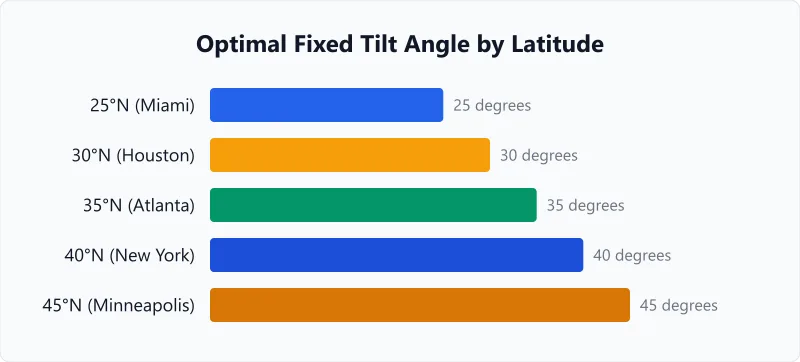
The best fixed tilt for solar panels is roughly equal to your latitude. A panel in New York at 41°N should sit near 41°; one in Phoenix at 33°N near 33°. The US Department of Energy Federal Energy Management Program puts the optimal tilt at the local latitude, and the PVWatts documentation calls it a common rule of thumb. Latitude tilt captures the most energy across the full year. Modelled sky conditions put the optimum lower: NASA POWER's modelled optimal tilt for New York is 31.0°, below the 41° the rule gives. For more seasonal output, subtract about 15° in summer and add about 15° in winter. The ±15° offsets are our own estimate; no published source backs them. Check your results against your product data or a licensed professional before acting.
The quick reference below sets a fixed, year-round tilt by latitude. Pick the row closest to your location and tilt your array to roughly that angle.
| Latitude | Example Location | Fixed Tilt (≈ Latitude) |
|---|---|---|
| 33°N | Phoenix, USA | 33° |
| 40°N | Denver / New York, USA | 40° |
| 48°N | Seattle, USA | 48° |
| 51°N | London, UK | 51° |
| 34°S | Sydney / Cape Town | 34° (face north) |
These figures are starting points for a permanent install. The detailed table later in this guide splits each latitude band into separate summer and winter angles for arrays you can adjust.
The optimal solar panel angle depends on one number above all others: your latitude. A panel tilted to match your latitude faces the sun more directly across the year, capturing more energy than a flat or arbitrarily angled installation. The difference between an optimized tilt and a flat installation can be 15-30% of annual production — real money over a 25-year system life.
Our solar panel angle calculator gives you the precise tilt for your location by season. This guide explains the underlying geometry and helps you decide whether seasonal adjustment, fixed tilt, or tracking makes sense for your situation.
Why Tilt Angle Matters
The U.S. receives between 3 and 7 peak sun hours per day depending on location and season, according to NREL solar resource maps (page no longer available at time of checking). A panel at the wrong angle wastes a portion of those hours. In Phoenix (5.7 peak hours at optimal tilt), a 15° tilt error costs roughly 0.4 peak hours per day — about 240 kWh per year on a 6 kW system. In Seattle (3.6 peak hours), the same error costs proportionally less in absolute terms but more as a percentage of already-scarce production.
If you want to understand how tilt affects your total energy harvest and system economics, our solar panel payback period guide walks through the financial math.
Solar panels produce the most electricity when sunlight hits them at a 90-degree angle (perpendicular to the panel surface). As the angle of incidence moves away from perpendicular, energy capture drops following a cosine relationship. At 30 degrees from perpendicular, you lose about 13% of potential output. At 60 degrees, you lose 50%.
The sun's height in the sky changes with both season and latitude. In summer, the sun rides high; in winter, it stays low. The ideal panel angle compensates for this by tilting the panel to face the sun's average position. At higher latitudes the sun stays lower year-round, so panels need steeper tilts.
For a fixed installation (no seasonal adjustment), the general rule is: tilt angle = latitude. This maximizes total annual production by splitting the difference between the high summer sun and low winter sun. It is not perfect for either season, but it is the best single compromise.
Worked Example: 40°N Latitude (New York, Denver, Madrid)
A homeowner at 40°N latitude in Denver, Colorado installs a 6 kW south-facing solar array. Using NREL PVWatts data, here is what different tilt angles produce annually:
Flat (0°): 8,040 kWh/year — worst case. The panel never faces the sun optimally and catches rain/snow/dust accumulation.
20° tilt: 8,900 kWh/year — 10.7% better than flat. A shallow angle common on low-slope commercial roofs.
40° tilt (= latitude): 9,450 kWh/year — 17.5% better than flat. The annual optimum. This captures the most total energy across all four seasons.
55° tilt (winter-optimized): 9,100 kWh/year — better than flat but worse than 40° annually. Captures more winter sun at the cost of missing summer production. Only makes sense if you need maximum winter output (off-grid cabin with winter heating loads).
The gap between flat and optimal is 1,410 kWh/year. At $0.14/kWh (Colorado average), that is $197/year — nearly $5,000 over the system's life. On a 6 kW system costing $18,000 installed, the tilt alone shaves 2+ years off the payback period.
Optimal Angles by Latitude and Season
This table shows recommended tilt angles for fixed and seasonally adjusted installations across latitude ranges. All angles are measured from horizontal.
| Latitude Range | Fixed Year-Round Tilt | Summer Tilt | Winter Tilt | Annual Gain from Seasonal Adj. |
|---|---|---|---|---|
| 25-30°N (Miami, Houston, Cairo) | 25-30° | 10-15° | 40-45° | 5-8% |
| 30-35°N (Phoenix, Dallas, Tokyo) | 30-35° | 15-20° | 45-50° | 6-10% |
| 35-40°N (LA, Denver, Madrid) | 35-40° | 15-20° | 50-55° | 7-10% |
| 40-45°N (NYC, Chicago, Rome) | 40-45° | 20-25° | 55-60° | 8-12% |
| 45-50°N (Seattle, Montreal, Paris) | 45-50° | 25-30° | 60-65° | 10-15% |
| 50-55°N (London, Berlin, Calgary) | 50-55° | 30-35° | 65-70° | 12-18% |
The "Annual Gain from Seasonal Adjustment" column shows how much extra production you get by changing the tilt angle twice per year (once for summer, once for winter) compared to a fixed installation. At higher latitudes, the gain is larger because the sun angle changes more dramatically between seasons.
The seasonal columns follow a well-known rule of thumb: set the summer tilt to your latitude minus 15° and the winter tilt to your latitude plus 15°. A widely cited solar tilt analysis by Charles Landau refines this for mid-latitudes, putting the best year-round fixed tilt near latitude times 0.76 plus 3.1° (about 34° at 40°N rather than a flat 40°). The simple tilt-equals-latitude rule is the right starting point; treat the refinement as a few-degree tweak, not a different answer. Local weather, horizon obstructions, and snow shift the ideal by a similar margin anyway.
Southern Hemisphere: Same Tilt, Opposite Direction
The latitude rule works the same way south of the equator, with one change: panels face true north instead of true south. A rooftop in Sydney or Cape Town near 34°S tilts about 34°; one in Christchurch at 44°S tilts about 44°. The seasons flip too, so the flatter summer angle (latitude minus 15°) applies during December and January, while the steeper winter angle applies around June and July. Off-grid sites in Chile, Argentina, and New Zealand follow the same math as their Northern Hemisphere counterparts at the matching latitude. An array that mistakenly faces south below the equator can lose 30-40% of its annual yield, the same penalty a north-facing roof pays in the north.
Fixed Tilt vs. Seasonal Adjustment vs. Tracking
Three mounting strategies exist, each with different cost-benefit profiles.
Fixed tilt at latitude is the standard for residential rooftop solar. No moving parts, no maintenance, lowest cost. You sacrifice 5-15% of potential production compared to seasonal adjustment, but avoid the complexity and labor of climbing on the roof twice a year. For most grid-connected homeowners, fixed tilt is the right choice — the payback on the extra effort of seasonal adjustment rarely justifies it when electricity is cheap and plentiful from the grid.
Seasonal adjustment (changing tilt 2-4 times per year) makes sense for ground-mounted systems with easy access to the mounting hardware, especially for off-grid systems where every kilowatt-hour counts. Adjusting between summer and winter angles adds 5-15% annual production. On a 10 kW system, that is 500-1,500 kWh/year — $75-$225 at average rates. This matters more for off-grid systems where every kWh counts and winter production is the bottleneck. Use the solar panel size calculator to find the right array size for your seasonal production needs.
Single-axis trackers follow the sun from east to west throughout the day, adding 20-30% annual production versus fixed tilt. Dual-axis trackers also adjust for seasonal sun height, adding 30-45%. Trackers cost $2,000-$5,000 per kW and have moving parts that require maintenance. They are economically viable only for large ground-mount installations or high-value-per-kWh applications (off-grid, commercial, agriculture). For a typical residential rooftop, the tracker cost exceeds the value of extra production.
Practical Installation Considerations
Your roof pitch might already be close enough. Standard residential roof pitches in the US range from 4/12 (18°) to 8/12 (34°). If you live at 35°N latitude and your south-facing roof is pitched at 30°, you are within 5° of optimal — close enough that the energy loss is under 2%. Spending extra on tilt-adjusting mounts to gain 2% is rarely worth the cost.
Orientation matters as much as tilt. A south-facing panel at a suboptimal tilt produces more than a perfectly tilted east or west-facing panel. If your best roof face points east or west, expect 10-15% less annual production regardless of tilt optimization. Our solar output calculator factors in both orientation and tilt.
Snow shedding favors steeper tilts. In snowy climates, panels tilted above 35-40° shed snow naturally. Flatter installations accumulate snow that blocks production until it melts. As our solar panel output guide explains, even partial obstruction cuts production disproportionately due to how cells are wired in series. If you are in a region with heavy winter snow, biasing 5° steeper than the annual optimum can improve net winter production even though the angle is not geometrically ideal.
Wind loading increases with tilt. Steeper panels catch more wind. Building codes and structural engineering requirements may limit tilt angles based on your local wind zone, especially for ground mounts and flat-roof ballasted systems. Check local building requirements before designing a steep-tilt installation. The solar time calculator can help you plan around your location's specific solar geometry.
Frequently Asked Questions
Written and maintained by Dan Dadovic, Commercial Director at Ezoic Inc. & PhD Candidate in Information Sciences. He works professionally as Commercial Director at Ezoic Inc., leading revenue strategy across digital publishing.
Disclaimer: Calculator results are estimates based on theoretical formulas. Actual performance varies with temperature, battery age, load patterns, and equipment condition. For critical electrical work, consult a licensed electrician.
Methodology reviewed by Doc. dr. sc. Damir Topić, Assistant Professor, FERIT Osijek.