Why a Space Heater Is One of the Priciest Things You Plug In
An electric space heater turns nearly every watt it draws into heat, which sounds efficient, and at the point of use it is. The catch is the sheer size of the load. A 1,500 W heater sits right at the ceiling for a standard 120-volt outlet: at 12.5 amps it uses most of a 15-amp circuit on its own, which is why running one on an extension cord or sharing the circuit with other loads is a common cause of tripped breakers and overheated cords. That same 1,500 W is more than ten typical LED bulbs, a laptop, and a television running together.
Because resistive heat has no efficiency rating to shop for — every brand converts watts to heat at the same rate — the only levers on cost are how many watts you draw, how long it runs, and how often the thermostat lets it rest. For a single reading on any device where you already know the wattage, the electricity cost calculator takes watts directly; this page adds the heater-specific duty cycle and heating-season framing on top.
What a Space Heater Costs at Each Wattage Setting
Most heaters offer two or three settings. The table below runs the common ones through the same assumptions — a 70% thermostat duty cycle, 8 hours a day, and $0.17/kWh — so the only variable is the wattage you select.
| Setting | Avg Draw (70% duty) | Monthly Cost* | Season Cost* |
|---|---|---|---|
| 750 W (low) | 525 W | $21.42 | $107.10 |
| 1,000 W (medium) | 700 W | $28.56 | $142.80 |
| 1,500 W (high) | 1,050 W | $42.84 | $214.20 |
Typical wattages are our own estimates; check your appliance's nameplate.
*At 8 hrs/day, 70% duty, and $0.17/kWh over a 150-day season. Prices and rates on this page are our own estimates as of the date shown; they change often. Enter your own figures for a current result. The pattern is linear: the low setting costs almost exactly half the high setting, because heat output tracks wattage directly. If the smaller output still keeps the room comfortable, the low setting is free money. To see how a heater ranks against the other big loads in the house, the appliance electricity cost calculator sorts them by annual cost.
Space Heater vs Heat Pump vs Central Heat
A space heater looks cheap because it is: $20 to $80 to buy, nothing to install. The running cost is where it catches up with you. The most useful comparison is not against another space heater but against the alternatives for the same warmth.
Versus central heating. If you are heating the whole house anyway, a space heater on top adds cost rather than saving it. The space heater only wins when you are zone heating, keeping one occupied room warm while the central system is turned down or off. In that narrow case, one 1,500 W heater at about $43 a month can undercut running a furnace for the whole house. Heat two or three rooms this way and the math flips back the other way.
Versus a heat pump. A ductless mini-split heat pump moves heat instead of generating it, so it delivers the same warmth for far less electricity. The U.S. DOE’s guidance on electric resistance heating notes a heat pump cuts electricity use by about half compared with a resistance heater. A heat pump costs $1,500 to $3,000 installed, but for a room you heat every day it usually pays back in a few winters. For a whole-home efficiency picture across heating, cooling, and water heating, the electricity bill estimator builds the full monthly total.
Worked Examples
A 1,500 W Office Heater Through the Winter
Context
You run a 1,500 W ceramic space heater in a home office 8 hours a day. A built-in thermostat holds the room at a comfortable temperature, so the element actually draws power about 70% of that time. Your electricity rate is $0.17/kWh, and the heating season runs roughly 150 days (November through March). What does the heater add to the bill?
Calculation
Average draw: 1,500 W × 70% = 1,050 W
Daily energy: 1,050 W × 8 h ÷ 1,000 = 8.4 kWh
Daily cost: 8.4 kWh × $0.17 = $1.43
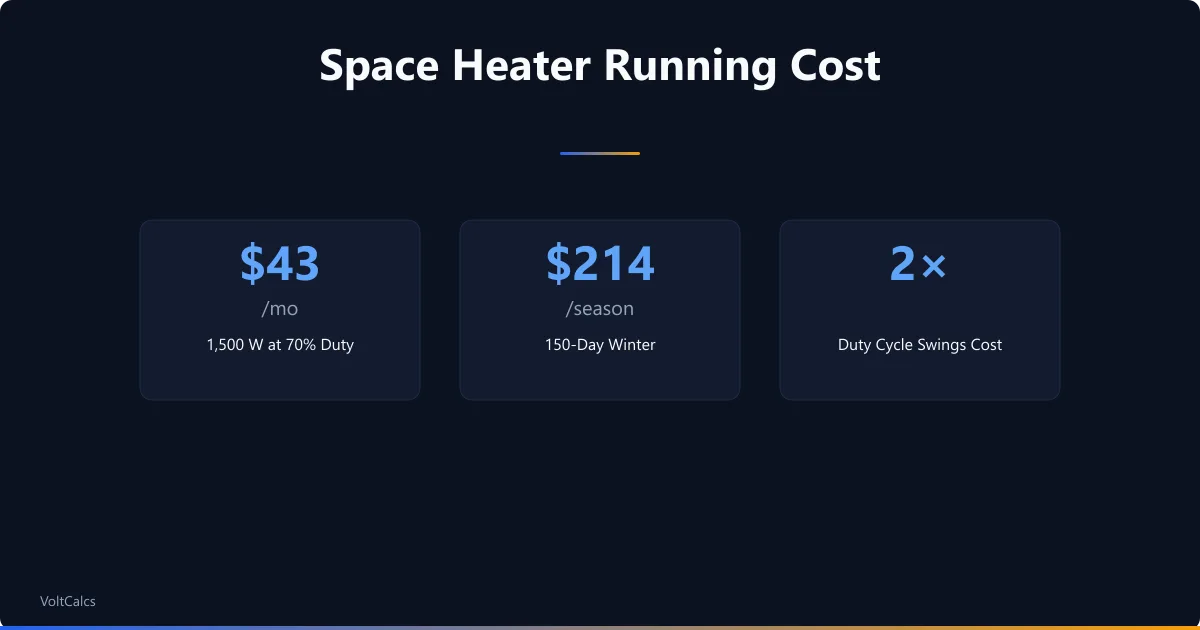
Monthly cost: 8.4 kWh × 30 × $0.17 = $42.84
Full season (150 days): 8.4 kWh × 150 × $0.17 = $214.20
Interpretation
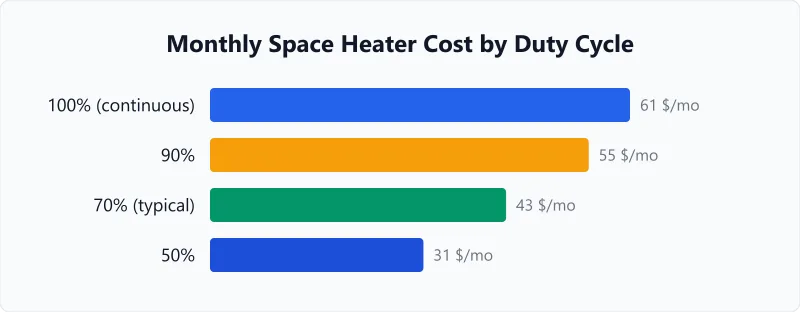
About $43 a month, or $214 for the winter, from a single heater. Run a second one in another room and it doubles. If the thermostat never cycled and the element ran flat out, the same heater would cost about $61 a month instead of $43, which is why the duty-cycle figure matters more than the wattage printed on the box.
Takeaway
Heating a room off-grid changes the stakes: 1,050 W is a heavy continuous draw for a battery bank. Drop that figure into the battery runtime calculator to see how quickly it flattens a typical bank — the answer is usually a couple of hours, not overnight.
The Same Heat for Less on a 750 W Low Setting
Context
Instead of the high setting, you run the same heater on its 750 W low setting to take the chill off a small, well-sealed room. It stays on continuously (no thermostat cycling) for 6 hours each evening across the 150-day season at $0.17/kWh. How does the cost compare?
Calculation
Average draw: 750 W × 100% = 750 W
Daily energy: 750 W × 6 h ÷ 1,000 = 4.5 kWh
Daily cost: 4.5 kWh × $0.17 = $0.77
Monthly cost: 4.5 kWh × 30 × $0.17 = $22.95
Full season (150 days): 4.5 kWh × 150 × $0.17 = $114.75
Interpretation
Roughly half the cost of the high-setting example above, about $115 across the winter. Halving the wattage roughly halves the bill, so if a lower setting keeps the room comfortable it is the simplest saving available, with no new equipment and no thermostat math.
Takeaway
Planning to run heat from solar and batteries instead of the grid? Total the heater against your other loads in the off-grid load calculator before sizing an array — resistive heat is the single load most likely to blow an off-grid power budget.
Frequently Asked Questions
Glossary
Thermostat Duty Cycle
The share of on-time a heater’s element actually draws power. A thermostat cuts the element off once the room reaches temperature, then restarts it as the room cools, so a heater switched on for 8 hours might only draw power for 5 or 6 of them. Duty cycle is the largest source of real-world cost variation: the same heater costs far less in a warm, well-insulated room than in a cold, draughty one.
Resistive Heating
Heat produced by passing current through a high-resistance element, as in a ceramic, fan, oil-filled, or infrared space heater. It is close to 100% efficient at the point of use, meaning the nameplate wattage equals the heat output, with no efficiency rating to compare. This is why every electric-resistive heater of the same wattage costs the same to run.
Heating Season
The stretch of the year a space heater is in use, often November through March, or about 150 days in much of the US. Running cost scales directly with season length, so a longer or colder winter multiplies the total. The season total is usually the number people mean when they ask what a heater costs to run.
Kilowatt-Hour (kWh)
A unit of energy equal to 1,000 watts drawn for one hour. It is what the utility bills for, and it is the bridge between a heater’s wattage and its cost: watts times hours divided by 1,000 gives kWh, and kWh times your rate gives dollars.
A space heater is usually a winter spike on top of a baseline — our household energy-audit guide shows how to find every load that matters, biggest first.
Related calculators
Air Conditioner Running Cost Calculator
Estimate what your air conditioner costs to run per day, month, and year from its BTU rating and SEER or EER, with duty cycle and your own rate built in.
Electrical
Appliance Electricity Cost Calculator
See exactly what each appliance costs to run by day, month, and year. Enter wattage, hours of use, and your rate to rank household energy hogs.
Electrical
Electricity Cost Calculator
See the daily, monthly, and annual electricity bill impact of running any device. Plug in wattage, hours, and your utility rate for a full cost breakdown.
Electrical
Water Heater Electricity Cost Calculator
Compare tank, tankless, and heat pump water heater operating costs with DOE UEF math. Inputs: gallons/day, set temp, inlet temp, and rate.
Electrical
The honest bottom line: a space heater’s running cost is set by how you use it, not by the badge on the box. Every electric-resistive heater converts watts to heat the same way, so the wattage you choose, the hours you run it, and how often the thermostat rests the element decide the bill, and your local rate scales all of it. Use the sensitivity table in the results to see the swing between a heater that idles and one that runs flat out, and enter your own rate from a recent statement rather than a national average. For how that rate is actually built from energy, delivery, and demand charges, our guide to understanding electricity costs breaks down a real bill line by line.
More Electrical calculators
Browse all electrical calculators — Motor FLA, wire sizing, voltage drop, load calculations, and transformer fusing based on NEC standards.
Last updated:
Written and maintained by Dan Dadovic, Commercial Director at Ezoic Inc. & PhD Candidate in Information Sciences. He works professionally as Commercial Director at Ezoic Inc., leading revenue strategy across digital publishing.
Disclaimer: Calculator results are estimates based on theoretical formulas. Actual performance varies with temperature, battery age, load patterns, and equipment condition. For critical electrical work, consult a licensed electrician.
Methodology reviewed by Doc. dr. sc. Danijel Jerković-Štil, Assistant Professor, FERIT Osijek.