What Appliances Actually Cost to Run at Home
Last updated:
12 min read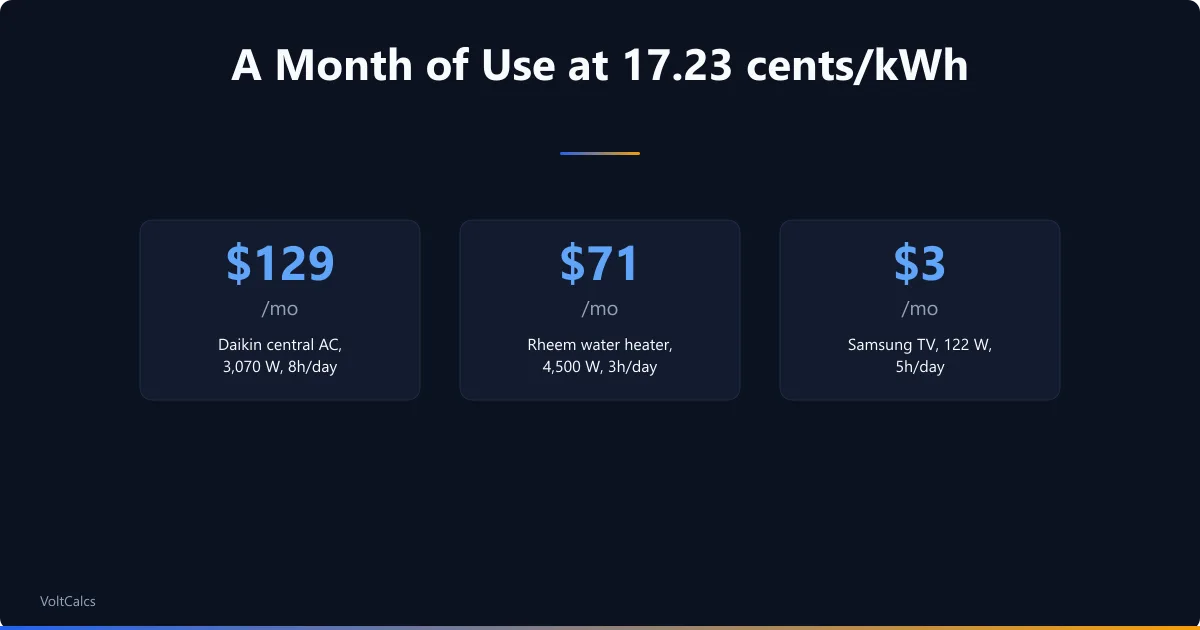
The line items behind a household electricity bill are wildly uneven. Three or four loads do almost all the damage, and the rest add up to less than people think. The fastest way to cut your bill is not unplugging chargers. It is finding which appliances are quietly burning the bulk of your kWh, then deciding whether to replace them, run them differently, or accept the cost. The appliance electricity cost calculator handles the per-device math; this guide walks through the audit method that tells you which devices to plug into it first.
The 90/10 Pattern Behind Every Electricity Bill
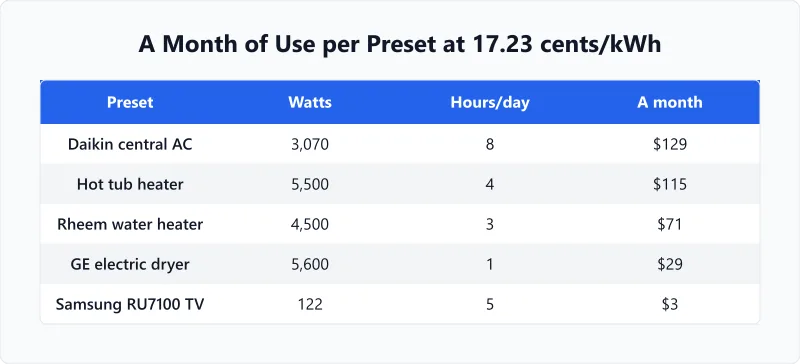
If you list every appliance in a home and rank them by cost, the top three or four sit far above the rest. The presets of our appliance electricity cost calculator show the spread: at their own hours a day and 17.23 cents per kWh, a month of use costs about $129 for a Daikin central AC, $115 for a hot tub heater, $71 for a Rheem water heater, $29 for a GE electric dryer and $3 for a Samsung RU7100 TV. Everything else combined (phone chargers, lamps, microwaves used twice a day, the toaster, the kettle, the smart speaker) adds up to a small share of the bill. This is not a quirk of one or two homes. The same shape repeats across climate zones, square footages, and rate plans because the physics is the same: a few loads have very high wattage, very long duty cycles, or both.
The EIA Residential Energy Consumption Survey shows the same top categories year after year: space heating, space cooling, water heating, and refrigeration. Together those four account for 55-70% of residential electricity in homes where heating runs on electricity, and 40-55% in homes that heat with gas or oil. If your bill is high and you do not know which appliance is responsible, statistics say the answer is one of those four. Our electricity bill estimator reflects this distribution by category: it asks for HVAC, water heating, refrigeration, and a handful of others, not for individual appliances, because the long tail does not change the bill total enough to be worth itemizing.
The Pareto pattern matters because it changes how you spend audit effort. Spending an hour with a Kill A Watt on every device in the house is mostly wasted time. Spending the same hour on the top three (measuring the fridge over 24 hours, getting an accurate hourly draw on the AC, checking the water heater's actual recovery rate) gives you the data that drives real decisions. The chart below draws a month of use for each of those five presets of the appliance electricity cost calculator, with its watts and hours a day, at 17.23 cents per kWh.
A 30-Minute Audit That Beats Guesswork
The starting point is your bill, not your appliances. Pull the last 12 monthly bills from your utility website (most utilities show at least two years of history). Look at the kWh column, not the dollar column. Two patterns reveal almost everything.
First: how much does your usage swing seasonally? A flat line (same kWh in January as in July) means HVAC is not your dominant load, so the top of the list is probably water heating, refrigeration, or pool/well pumps. A summer spike means central or window AC is the top slot. A winter spike means electric heating (resistance, baseboard, or heat pump) is the top slot. A double peak in both seasons means HVAC dominates year-round.
Second: what is your shoulder-season baseline (the kWh used in April or October, when neither heating nor cooling is running much)? That number is your "always-on" load: refrigeration, lighting, electronics, water heating, well pumps, and any electric devices that run no matter the weather. If your shoulder-month bill is 700-900 kWh, your always-on load is normal. Above 1,000 kWh and something is unusual: often a hot tub, pool pump, well pump in a poorly insulated well house, or an old refrigerator pulling 250-300W average.
From there, three questions narrow the diagnosis fast. What heats your home and water: gas or electric? How old is the refrigerator and is there a second one (basement, garage)? Are there any "always running" loads (pool, hot tub, sump pump, well pump, aquarium, dehumidifier) that you have stopped noticing? Answer those three and you have your top suspects without measuring anything yet. Now you measure those specific loads with a Kill A Watt or smart plug, leaving every-other-room electronics alone.
Heating and Cooling: Always the Top Slot
HVAC dominates because it combines high wattage with long duty cycles in extreme weather. Daikin's spec sheet prints 3.07 kW for its DC3SEN3610A split-system air conditioner at 95°F outdoors. In a hot week with the unit cycling on for half of every hour for 16 hours a day, it runs 8 hours a day: that is 24.6 kWh per day, or $4.23 per day at 17.23 cents per kWh, the calculator's default rate. Prices and rates on this page are our own estimates as of the date shown; they change often. Enter your own figures for a current result. Over 90 such days of cooling, it is $380.85 just for the AC, even before you account for backup electric resistance heating from the air handler.
Resistance electric heating is even more expensive. A baseboard or wall heater pulls 1,500W flat-out and runs continuously when the room is not warm enough. Two or three rooms heated by resistance baseboards in a cold climate add to the bill in step with how many heaters run and for how long. Lasko prints 900 W to 1500 W for its space heater. At its 1,500W top setting, used 8 hours a day for five winter months, November through March (151 days), one heater uses 1,812 kWh and adds $312.21 at 17.23 cents per kWh, the calculator's default rate (1.5 kW x 8 hours x 151 days x $0.1723). People often run several at once in cold rooms a central system cannot reach.
The size of the savings opportunity matches the size of the cost. Sealing duct leaks alone reduces HVAC runtime 20-30% in homes with attic or crawlspace ductwork, which is most of the US housing stock. Adding insulation to an undersealed attic typically cuts heating and cooling runtime 15-25%. Replacing a 15-year-old central AC unit with a modern variable-speed heat pump cuts cooling electricity 30-50% and electrifies heating at 2-3× the efficiency of resistance. None of these are small fixes, but the payback math works at today's rates because the underlying load is so large to start with. The DOE's heat pump systems guide walks through the technology choice in detail.
If your bill is dominated by HVAC, every other appliance audit is secondary. Get the heating-and-cooling number right first; the rest is rounding error in comparison.
Always-On Loads You Stop Noticing
The second category is loads that run continuously or near-continuously, and that you stopped consciously thinking about years ago. The biggest is your refrigerator, which stays plugged in all day and all night. Its compressor cycles around the clock, so even modest wattage adds up to real money. A refrigerator is rated in kWh a year on its yellow EnergyGuide label: price that figure at your own rate, rather than a wattage times 24 hours. Old or oversized fridges, or any second fridge in a hot garage, can cost far more: a plug-in meter over a few days shows yours.
Well pumps and sump pumps fall into the same bucket. A 1HP submersible well pump pulls 1,200-1,500W when running, and in a typical residential setup it cycles on briefly hundreds of times per day. Its yearly cost turns on how often it starts and how long each run lasts, so measure it rather than guess. A constantly running pond pump or aquarium chiller costs more because it never stops, and it almost never shows up in homeowners' mental models because it has been quietly running since the day it was plugged in.
Network gear and standby boxes are the smallest of the always-on category but the most numerous. A cable or streaming box pulls 15-30W in standby. A WiFi router and mesh nodes draw 10-20W combined, around the clock. A home network rack with a switch, a NAS, and security cameras can pull 50-100W continuously. None of these is large in isolation, but together they run around the clock, every day of the year.
The audit move for always-on loads is to total their continuous wattage and multiply by 8,760 hours. Enter that total in the calculator at 24 hours a day for 365 days, and it prints their kWh and cost for the year at your rate. The number is rarely worth a hardware change on its own, but it sets a realistic floor for what your home draws when nothing is actively in use.
Episodic Loads That Hit Hard When They Run
The third bucket covers loads that draw enormous wattage but only intermittently: electric ovens, dryers, dishwashers, hot tubs, EV chargers, electric kettles, and resistive cookware. They are hard to budget mentally because the per-cycle cost is small but the cycles add up.
An electric clothes dryer draws the most while its heater runs: GE's own page prints 5,600W for its electric dryers. An hour at that draw uses 5.6 kWh, which is $0.96 at 17.23 cents per kWh, the calculator's default rate. An hour a day, five days a week, is 260 days a year: that is 1,456 kWh and $250.87 a year. A dishwasher with a heated dry cycle runs a heater on every load, so nightly use adds up over a year. An electric oven draws its full rating while it heats up and less while it holds 350°F, so an hour of baking uses less than its rating times one hour, and three bakes a week add up over a year.
The two episodic loads that surprise people are EV charging and hot tubs. A typical Level 2 home charger pulls 7,200W and is the largest single load in many EV-owning homes. Charging an EV that drives 12,000 miles per year at 3.5 miles per kWh costs about $548 annually at $0.16/kWh (an example rate), comparable to a large central AC bill. Our EV charging cost calculator prices a charge and a mile at the rate you enter. It uses one charging efficiency for Level 1, Level 2 and DC Fast, so at one rate the three levels cost the same per mile; enter the rate you pay at each to compare them. The EV cost spread across charging location, rate plan, and driver behavior is wide enough that the driver profiles in our EV charging cost guide run from $212 to $1,800 per year.
A hot tub is the worst offender per-unit-of-pleasure in most homes. Maintaining 102°F water year-round in an outdoor tub uses energy every day before anyone gets in, and how much depends on insulation, climate, and cover quality. Even a well-insulated tub pays all year just to hold its temperature. Anyone whose bill jumped after installing a hot tub is looking at the right culprit.
The Small-Stuff Myth: LEDs, Chargers, and Standby
The cultural narrative around saving electricity is wildly miscalibrated. People feel virtuous for unplugging their phone charger and feel resigned about their HVAC, when the math runs the opposite direction. A USB phone charger left in the wall with no phone attached pulls a fraction of a watt. Across an entire year that is a few kWh, a cost counted in cents. All of the phone chargers in a house, combined, cost less than running the AC for a single day in summer.
LED bulbs are a similar story. An LED bulb draws little, so a whole house of them, lit every evening, adds up to a real but modest lighting cost, dwarfed by a single bad fridge or a hot tub. The lighting upgrade is still worth doing, but framing it as the headline savings is wrong.
Standby loads from electronics deserve more attention than chargers but less than the main characters. A modern smart TV draws 0.5-1W when "off" but with network-keep-alive enabled. A game console in rest mode pulls 8-15W. A cable box draws 15-30W. Total all the standby loads in your entertainment center and enter that wattage in the calculator at 24 hours a day: it prints what they cost you around the clock. A smart power strip that cuts power to peripherals when the TV turns off recovers most of that, but the recovered amount is small relative to addressing one HVAC inefficiency.
The right framing is proportional. Spend optimization effort in proportion to the cost. Standby fixes are worth doing once, not worth iterating on. LED bulb replacement is worth doing once, then forgetting about. HVAC efficiency, water heating, and refrigeration are worth revisiting every few years as new technology and incentives shift the math.
Build Your Cost Ledger: A Field-Audited Example
Here is how the audit method plays out in a real 2,000 sqft single-family home in a mixed climate, with two adults, one EV, no pool or hot tub, and a 14-year-old central AC unit.
The annual bill breakdown after a weekend with a Kill A Watt and a smart panel monitor looks roughly like this, with each cost worked at an example rate of $0.16/kWh. Central AC and electric resistance backup heating: 4,200 kWh, or $672. Electric water heater (50-gallon tank, average household use): 4,100 kWh, or $656. EV home charging: 3,400 kWh, or $544. Refrigerator and chest freezer in garage: 1,400 kWh combined, or $224. Electric clothes dryer: 850 kWh, or $136. Cooking (electric range and microwave): 600 kWh, or $96. Lighting (mostly LED): 380 kWh, or $61. Network and standby loads: 450 kWh, or $72. Everything else combined (computers, TVs, small appliances): 720 kWh, or $115.
That total comes to roughly 16,100 kWh and $2,576 per year at the same example rate, high for a typical home, mostly because of the EV. The top three loads (HVAC, water heating, EV) account for $1,872, or 73% of the bill. Three of the smallest categories combined (lighting, network and standby loads, and everything else: computers, TVs and small appliances) total $248, or 10% of the bill. The math says: optimization effort spent on the top three pays back more than seven times what the same effort spent on those three small categories would.
For this household, with each saving a rough estimate at the example rate rather than a quoted figure, the priority list is heat-pump replacement of the AC and resistance heat (cuts the top category by 40-50%, saves $250-350 per year), a heat-pump water heater swap (cuts the second category by about 71%, the cut our water heater cost calculator prints for a heat pump at UEF 3.30 against a tank at UEF 0.95; at its own defaults the calculator prints $545 a year for the tank and $157 for the heat pump, about $388 saved, and on the example bill breakdown above, $656 a year at 16 cents, the same cut is about $467 per year), and a time-of-use rate plan for EV charging if the utility offers one (shifts the third category to off-peak rates, saves $100-200 per year). Three changes, $817-1,017 per year in savings, and the rest of the home stays exactly as it is.
Where to Spend the Effort First
Audits are useful only if they change behavior. The hardest part of the process is not measurement. It is resisting the temptation to act on every small finding. Three buckets cover where the effort actually pays back.
Bucket one: replacement of the dominant loads. Heat pumps for HVAC and water heating, modern fridges to replace anything older than 12-15 years. These are the only changes that move the bill total by hundreds of dollars per year. They cost real money up front. Incentives for them change and may have ended: before you buy, check the DSIRE database for what applies in your state.
Bucket two: rate plan and behavior shifts. Switch to time-of-use rates if you have flexible usage and a utility that offers them. Run the dishwasher and laundry overnight instead of during peak hours. Charge the EV between midnight and 6 AM. None of these cost anything; they just require attention. For a closer look at rate structures and how the per-kWh rate is built up, see our guide on the anatomy of an electricity bill.
Bucket three: baseline efficiency that compounds with everything else. Insulation, air sealing, LED lighting, smart power strips on entertainment centers. These are one-time upgrades with payback in 1-3 years. They are not headline savings, but they reduce the size of every other load category by a few percent, which compounds in homes that also do bucket-one work. To see how solar would shift the same equation by replacing grid kWh with on-site generation, plug your numbers into our solar ROI calculator for a full payback breakdown.
Frequently Asked Questions
Written and maintained by Dan Dadovic, Commercial Director at Ezoic Inc. & PhD Candidate in Information Sciences. On the energy side, Dan has hands-on experience with residential solar panel installation, DIY battery bank construction, off-grid power systems, wind power, and EV ownership/driving, all from building, maintaining, and operating his own systems.
Disclaimer: Calculator results are estimates based on theoretical formulas. Actual performance varies with temperature, battery age, load patterns, and equipment condition. For critical electrical work, consult a licensed electrician.
Methodology reviewed by Doc. dr. sc. Danijel Jerković-Štil, Assistant Professor, FERIT Osijek.