How the Math Works (Three Steps)
- BTU needed = gallons × 8.24 lb/gal × 1 BTU/lb·°F × ΔT. 8.24 lb per gallon is the density of water at 125°F that the DOE water heater test procedure prints (10 CFR 430 subpart B appendix E). ΔT is the difference between set and inlet temperature. Example at this page's defaults: 55 gal × 8.24 × 62°F (120-58) = 28,098 BTU/day delivered to the water.
- Convert BTU to kWh. 1 kWh = 3,412 BTU. So 28,098 / 3,412 = 8.235 kWh/day delivered to the water (the actual thermal energy it ended up holding).
- Divide by UEF to get grid kWh. UEF accounts for tank standby loss, recovery efficiency, and conversion losses. A tank at UEF 0.95 (the DOE FEMP less efficient electric row) means 8.235 / 0.95 = 8.67 kWh/day from the grid. A heat pump at UEF 3.30 (the ENERGY STAR minimum) means 8.235 / 3.30 = 2.50 kWh/day: heat pumps move heat, so UEF can exceed 1.
Multiply daily grid kWh by 365 and your rate to get annual cost. The calculator runs all three calculations automatically and shows the comparison.
Tank Electric vs Tankless Electric vs Heat Pump
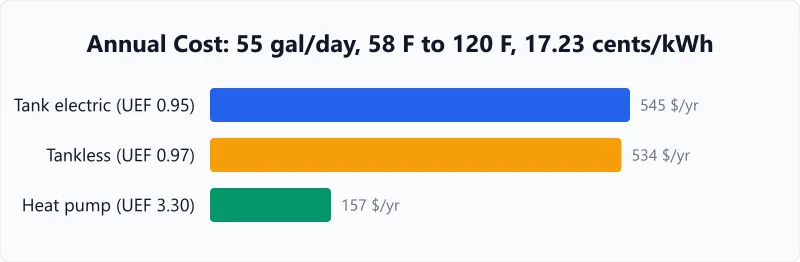
Tank electric (DOE FEMP less efficient electric row: UEF 0.95): Cheap to install ($500-900), 10-15 year lifespan, simple to service. Operating cost is the highest: at 64 gal/day with a 44°F inlet and 17.23 cents per kWh, a tank at UEF 0.95 costs $778/year. Prices and rates on this page are our own estimates as of the date shown; they change often. Enter your own figures for a current result. Standby loss accounts for 10-15% of total energy. Best fit: budget-constrained installs and rentals.
Tankless electric (Stiebel Eltron Tempra line: UEF 0.94 to 0.98; the Tempra 24 prints 0.97): Higher upfront cost ($800-1,500), 20-year lifespan, no standby loss. But the heat-on-demand model needs heavy circuits: at 240 V the Stiebel Eltron Tempra spec sheet lists two 50 A double-pole breakers for the Tempra 24, and across the line from one 50 A double-pole breaker (Tempra 12) through 2 x 30, 2 x 40, 2 x 50 and 3 x 40 to 3 x 50 A double-pole (Tempra 36). At UEF 0.97 the operating cost is about 2% lower than a tank at UEF 0.95 for the same usage. Best fit: small households, second/guest bathrooms.
Heat pump hybrid (ENERGY STAR minimum UEF 3.30; DOE FEMP best available 3.93): Highest upfront ($1,500-2,500 plus install), 12-15 year lifespan. At UEF 3.30 it uses about 71% less electricity than a tank at UEF 0.95. At 64 gal/day with a 44°F inlet and 17.23 cents per kWh it costs $224/year against the tank's $778. The catch: the heat pump pulls heat from surrounding air, so the unit needs ~750 cubic feet of conditioned space (basement, utility room) and a condensate drain. The federal 25C credit ended for property placed in service after 2025. Best fit: any homeowner with installation space.
For sizing the wire run from the panel to the heater, our wire distance calculator handles the conductor sizing for the heat pump branch circuit.
Inlet Temperature Matters More Than You Think
Water enters the heater at a temperature that varies with region and season. At a 120°F set point, a 40°F inlet needs a rise of 80°F and a 70°F inlet a rise of 50°F: for the same gallons the colder supply takes 60% more energy.
The default inlet, 58°F, is the supply water temperature of the DOE test procedure for water heaters (10 CFR 430 subpart B appendix E, section 2.3): "The temperature of the water being supplied to the water heater shall be maintained at 58 °F ± 2 °F". Your own supply may run colder or warmer: adjust the inlet input above to match it. Annual cost scales linearly with ΔT, so at the 58°F inlet, cutting set temperature from 130°F to 120°F (which is the DOE recommendation for most homes) cuts cost about 14%. To estimate the dollar payback of offsetting water heating with solar, our solar ROI calculator takes annual kWh load as input.
Worked Examples
Tank Electric at 64 Gallons a Day: Annual Cost
Context
A home uses 64 gallons of hot water per day. The water heater is set to 120°F and the inlet water is 55°F. The heater is a tank electric unit at UEF 0.95, the default this calculator takes from DOE FEMP's less efficient electric row. Electricity rate $0.16/kWh. What is the annual operating cost?
Calculation
ΔT = 120 - 55 = 65°F
Daily BTU = 64 × 8.24 × 65 = 34,278 BTU/day
Delivered kWh = 34,278 / 3,412 = 10.046 kWh/day
Grid kWh = 10.046 / 0.95 = 10.575 kWh/day
Annual kWh = 10.575 × 365 = 3,860 kWh
Annual cost = 3,860 × $0.16 = $618
Interpretation
About $618/year at these inputs. Cutting the set point to 115°F would save about $48/year (the calculator gives $570 at 115°F). Insulating the tank with a $30 insulation blanket saves another $30-40/year.
Takeaway
Tank electric is the baseline cost most homes pay. To compare with other heating types or against gas (where available), the same math applies with different UEF values. For single-device cost questions on any household appliance, our electricity cost calculator uses the same energy-cost framework.
Heat Pump Retrofit Payback
Context
The same 64 gal/day home above replaces the tank electric ($618/year) with a heat pump hybrid at UEF 3.30, the ENERGY STAR minimum. Equipment cost: $2,000. Installation: $700. The federal 25C credit ended for property placed in service after 2025. The full installed cost of $2,700 applies. Annual savings? Years to payback?
Calculation
New annual kWh = 10.046 / 3.30 × 365 ≈ 1,111 kWh (the calculator carries the unrounded daily figure)
New annual cost = 1,111 × $0.16 = $178
Annual savings = $618 - $178 = $440
Payback period = $2,700 / $440 = 6.1 years
Interpretation
Roughly 6-year payback, then pure savings for the rest of the heater’s 12-15 year life. Total lifetime savings (15 years × $440 - $2,700) = $3,900. State and utility rebates often add another $300-1,000 in front-loaded savings, dropping payback to 3.9-5.5 years.
Takeaway
Heat pump water heaters are usually the highest-ROI residential energy upgrade after LED retrofits. The catch is finding 750+ cubic feet of installation space in conditioned air. To estimate solar that would offset the remaining 1,111 kWh/year (about 93 kWh a month), our solar panel size estimator takes monthly kWh as input.
Frequently Asked Questions
Glossary
Uniform Energy Factor (UEF)
A DOE-mandated efficiency rating for water heaters per 10 CFR 430 Subpart B Appendix E. UEF combines recovery efficiency (how much input energy reaches the water), standby loss (energy lost from the tank when idle), and conversion losses (electrical-to-heat). Tank electric: the DOE FEMP less efficient electric row prints 0.95. Tankless electric: the Stiebel Eltron Tempra line prints 0.94 to 0.98. Heat pump: the ENERGY STAR minimum is 3.30 and the DOE FEMP best available row prints 3.93 (heat pumps move heat rather than generating it, so UEF exceeds 1).
Delta T (ΔT)
The temperature difference between the cold inlet water and the heater set point. ΔT drives the energy required: a 65°F ΔT (120°F set, 55°F inlet) needs 30% more energy than a 50°F ΔT. A colder supply means a larger ΔT, so the same household pays more for water heating where its supply runs cold.
Standby Loss
Heat that escapes from a hot water tank into the surrounding air when no water is being drawn. A typical tank electric loses 1-2% of its stored heat per hour. Over a full year of mostly-idle operation, standby accounts for 10-15% of tank electric total energy use. Tankless heaters have zero standby loss because they only heat on demand.
Recovery Rate
How quickly a water heater can reheat its tank after a major draw (e.g. a long shower or full bathtub fill). Tank electric recovers at 20-30 gallons per hour; gas tank at 30-45 GPH; heat pump hybrid at 8-15 GPH (their slow recovery is the main downside). Recovery rate matters most for households with concurrent hot-water demands like back-to-back showers.
Adding an EV charger is the other major new household load to plan around: our EV charging cost calculator prices a charge and a mile at the rate you enter, with one charging efficiency for Level 1, Level 2 and DC Fast.
Related calculators
Appliance Electricity Cost Calculator
See what an appliance costs per day and over the days you enter, with the annual figure at 365 days. Enter its wattage, daily hours, days and your rate.
Electrical
Electricity Cost Calculator
See the daily, monthly, and annual electricity bill impact of running any device. Plug in wattage, hours, and your utility rate for a full cost breakdown.
Electrical
Electricity Bill Estimator
Estimate a monthly electricity bill from four categories (HVAC, water heating, refrigeration, other) and your all-in rate, with defaults from RECS 2020.
Electrical
Kilowatt-Hour (kWh) Calculator
Calculate kilowatt-hours and energy cost for any appliance or device. Enter watts, hours of use, and your electricity rate for instant results.
Electrical
A reminder on the UEF numbers above. The defaults are named prints: the DOE FEMP less efficient electric row (0.95), the Stiebel Eltron Tempra 24 (0.97) and the ENERGY STAR heat pump minimum (3.30); the DOE FEMP best available heat pump row prints 3.93. Actual UEF varies by model, and the UEF field takes your own. Older tank electrics from before 2015 rate UEF 0.85-0.88. Tankless electrics rated at low flow (1.5 GPM) UEF 0.99 may drop to 0.94-0.95 at full flow. Always verify the EnergyGuide label on the specific model before sizing the install. For raw energy-quantity background on watt-hours and kilowatt-hours, our kWh calculator handles the conversion math. To put water heating in context against every other load in your home, our household electricity audit guide walks through the diagnostic that ranks loads from biggest to smallest.
More Electrical calculators
Browse all electrical calculators: Motor FLA, wire sizing, voltage drop, load calculations, and transformer fusing based on NEC standards.
Last updated:
Written and maintained by Dan Dadovic, Commercial Director at Ezoic Inc. & PhD Candidate in Information Sciences. On the energy side, Dan has hands-on experience with residential solar panel installation, DIY battery bank construction, off-grid power systems, wind power, and EV ownership/driving, all from building, maintaining, and operating his own systems.
Disclaimer: Calculator results are estimates based on theoretical formulas. Actual performance varies with temperature, battery age, load patterns, and equipment condition. For critical electrical work, consult a licensed electrician.
Methodology reviewed by Doc. dr. sc. Danijel Jerković-Štil, Assistant Professor, FERIT Osijek.