How the BTU-to-Dollars Math Works
Every cost estimate starts by turning cooling capacity into electrical draw. The EER on a unit’s label is its cooling output in BTU per hour divided by its power input in watts, so the full-load draw is simply BTU/hr ÷ EER. A 12,000 BTU unit rated EER 11 pulls about 1,091 watts when the compressor is running flat out.
Central systems and mini-splits are not labelled in EER. They carry a SEER (or SEER2) rating, a seasonal average measured across a range of outdoor temperatures rather than a single full-load point. This tool converts SEER to an equivalent EER using a widely-used DOE-standard approximation before working out watts. That conversion is genuinely approximate, so a SEER-rated estimate carries more uncertainty than an EER-rated one; real instantaneous efficiency varies by equipment.
Watts alone do not set the bill. A compressor rarely runs continuously; it cycles on and off to hold the thermostat setpoint. The fraction of time it actually runs is the duty cycle, and it is the largest single source of real-world variation. Multiply the average draw by the hours the unit is on, divide by 1,000 for kilowatt-hours, then multiply by your rate. For the raw watts-to-kWh step on any load, the kWh calculator shows the same arithmetic.
What Common AC Units Cost Per Month
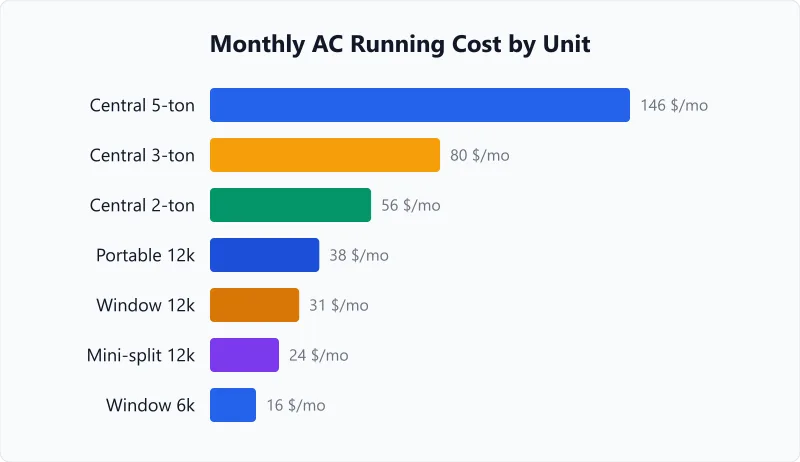
The table below runs seven representative units through the same assumptions: 8 hours a day, a 70% duty cycle, and $0.17/kWh. Avg draw is the compressor’s average power after duty cycle; monthly cost is 30 days at that draw.
| Unit | Capacity | Rating | Avg Draw | Monthly Cost* |
|---|---|---|---|---|
| Small window | 6,000 BTU | EER 11 | 382 W | $15.58 |
| Mini-split | 12,000 BTU | SEER 20 | 583 W | $23.80 |
| Medium window | 12,000 BTU | EER 11 | 764 W | $31.16 |
| Portable | 12,000 BTU | EER 9 | 933 W | $38.08 |
| Central 2-ton | 24,000 BTU | SEER 15 | 1,366 W | $55.73 |
| Central 3-ton | 36,000 BTU | SEER 16 | 1,969 W | $80.33 |
| Central 5-ton | 60,000 BTU | SEER 14 | 3,571 W | $145.71 |
*At $0.17/kWh, 8 hrs/day, 70% duty cycle. Prices and rates on this page are our own estimates as of the date shown; they change often. Enter your own figures for a current result. Two patterns stand out. A high-efficiency mini-split costs far less to run than a window unit of the same BTU ($23.80 versus $31.16 a month here) because its seasonal rating is so much higher. And central systems dominate the bill purely on size: a 5-ton unit moves five times the heat of a 1-ton window unit, so it costs roughly nine times as much to run.
Cutting Your AC Running Cost
- Raise the setpoint a few degrees. Each degree higher cuts run time and the compressor cycles less, dropping duty cycle. Going from 70°F to 76°F trims cooling cost 15-25% in a typical home.
- Right-size the unit. An oversized AC short-cycles and an undersized one runs near 100% duty in heat, and both cost more than a correctly matched unit. Match BTU to the room, not to the biggest box on the shelf.
- Replace a low-SEER central system. Swapping a SEER 14 unit for a SEER 20 mini-split cuts the per-BTU running cost by about 18% (by the SEER-to-EER conversion above). Use the electricity bill estimator to see the whole-home impact across every category.
- Offset cooling with solar. AC load peaks in the afternoon, exactly when rooftop panels produce most. The solar ROI calculator shows the payback period when summer cooling is the load you are sizing for.
Worked Examples
A Window Unit Through a Hot Month
Context
You run a 12,000 BTU window air conditioner rated EER 11 for 8 hours a day during a hot stretch. In your area the compressor runs about 70% of that time, and your electricity rate is $0.17/kWh. What does the unit cost for the month?
Calculation
Full-load draw: 12,000 BTU/hr ÷ 11 EER = 1,091 W
Average draw at 70% duty: 1,091 × 0.70 = 764 W
Daily energy: 764 W × 8 h ÷ 1,000 = 6.11 kWh
Monthly cost: 6.11 kWh × 30 × $0.17 = $31.16
Interpretation
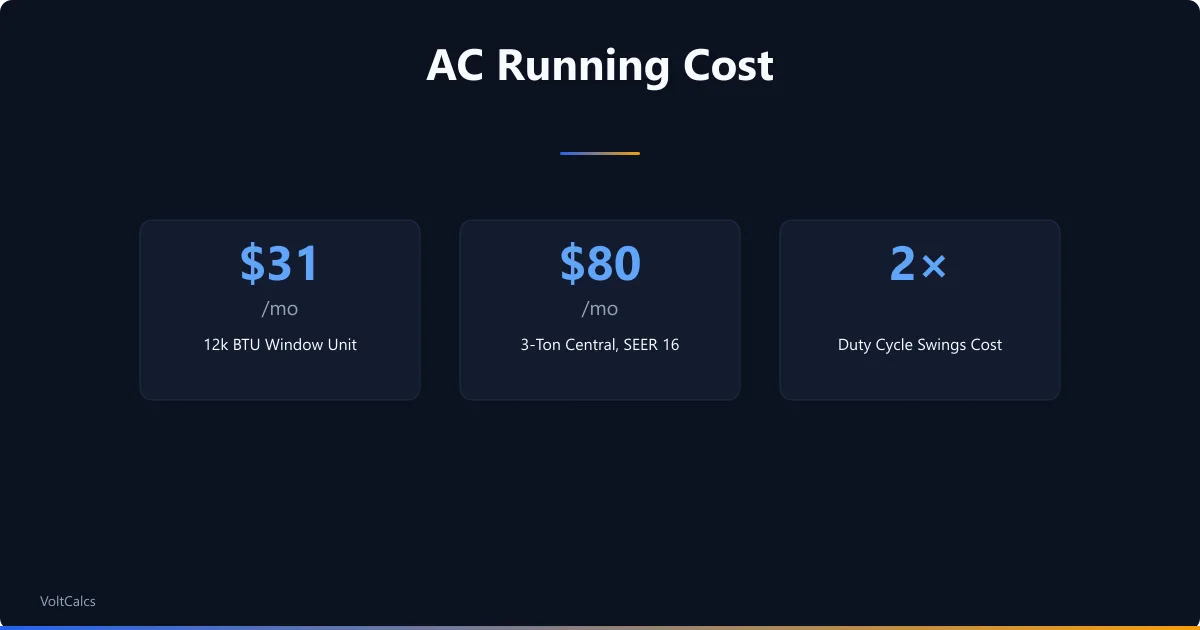
About $31 a month while you are running it hard. Because EER maps straight to watts, this is the most direct of the two rating paths, with no SEER conversion involved. Cost scales directly with duty cycle, so the same unit costs noticeably less in mild weather when the compressor cycles off more often.
Takeaway
For a quick estimate on any single device where you already know the wattage, the electricity cost calculator takes watts directly and skips the BTU and efficiency step.
A 3-Ton Central System on SEER
Context
Your home has a 3-ton central air conditioner, which is 36,000 BTU/hr, rated SEER 16. It runs 8 hours a day at a 70% duty cycle, and you pay $0.17/kWh. What is the monthly running cost?
Calculation
SEER to EER: −0.02 × 16² + 1.12 × 16 = 12.80 EER
Full-load draw: 36,000 BTU/hr ÷ 12.80 = 2,813 W
Average draw at 70% duty: 2,813 × 0.70 = 1,969 W
Daily energy: 1,969 W × 8 h ÷ 1,000 = 15.75 kWh
Monthly cost: 15.75 kWh × 30 × $0.17 = $80.33
Interpretation
About $80 a month for the season’s peak usage. The SEER 16 rating converts to 12.80 EER, noticeably lower than the headline SEER — that gap is the seasonal-average effect, and it is why a SEER number alone overstates how cheaply a unit runs at full load on the hottest days.
Takeaway
Running central AC during an outage means a large inverter and battery bank. The solar panel and battery sizing calculator sizes the system around a load this size.
Frequently Asked Questions
Glossary
BTU and Tons
A British Thermal Unit (BTU) is the heat needed to raise one pound of water by one degree Fahrenheit; for air conditioners, capacity is quoted in BTU per hour. A ton of cooling equals 12,000 BTU/hr, so a 3-ton unit is 36,000 BTU/hr. Window units typically run 5,000 to 14,000 BTU/hr; central systems run 24,000 to 60,000.
EER (Energy Efficiency Ratio)
EER is a unit’s cooling output in BTU per hour divided by its electrical input in watts, measured at a single full-load test point (95°F outdoor). It maps directly to power draw: watts equal BTU/hr divided by EER. Window, portable, and PTAC units are labelled in EER or the closely related CEER.
SEER and SEER2
SEER is the seasonal version of EER: total cooling output across a simulated cooling season divided by total watt-hours consumed, so it averages in part-load and milder temperatures. SEER is always higher than the same unit’s EER. Central systems and mini-splits are rated in SEER, or SEER2 under the test procedure adopted in 2023.
Duty Cycle
The duty cycle is the share of time the compressor actually runs while the unit is switched on. A correctly sized AC in mild weather might run 50 to 60% of the time; in a heatwave or when undersized it can run near 100%. Because energy use scales with run time, duty cycle is the largest source of real-world cost variation.
AC is usually the top line on a summer bill, but the same method ranks every load — our guide to what household appliances really cost to run walks through the 30-minute audit.
Related calculators
Electricity Cost Calculator
See the daily, monthly, and annual electricity bill impact of running any device. Plug in wattage, hours, and your utility rate for a full cost breakdown.
Electrical
Electricity Bill Estimator
Estimate your full monthly electricity bill by category: HVAC, water heating, fridge, lighting, electronics, cooking, laundry, plus fixed delivery charges.
Electrical
Appliance Electricity Cost Calculator
See exactly what each appliance costs to run by day, month, and year. Enter wattage, hours of use, and your rate to rank household energy hogs.
Electrical
Water Heater Electricity Cost Calculator
Compare tank, tankless, and heat pump water heater operating costs with DOE UEF math. Inputs: gallons/day, set temp, inlet temp, and rate.
Electrical
The honest takeaway: an air conditioner’s running cost is set less by the sticker efficiency than by how you run it. Duty cycle, your local rate, insulation, and outdoor temperature each move the number more than a point or two of SEER does. The duty-cycle table built into the results panel makes that explicit — the same unit can cost half as much in mild weather as it does in a heatwave. Use the calculator to compare units before you buy and to sanity-check a bill that looks high, but pair it with your real rate from a recent statement. For how that rate is actually built from energy, delivery, and demand charges, our guide to electricity costs breaks down the line items.
More Electrical calculators
Browse all electrical calculators — Motor FLA, wire sizing, voltage drop, load calculations, and transformer fusing based on NEC standards.
Last updated:
Written and maintained by Dan Dadovic, Commercial Director at Ezoic Inc. & PhD Candidate in Information Sciences. He works professionally as Commercial Director at Ezoic Inc., leading revenue strategy across digital publishing.
Disclaimer: Calculator results are estimates based on theoretical formulas. Actual performance varies with temperature, battery age, load patterns, and equipment condition. For critical electrical work, consult a licensed electrician.
Methodology reviewed by Doc. dr. sc. Danijel Jerković-Štil, Assistant Professor, FERIT Osijek.