What Reserve Capacity Actually Measures
Reserve capacity was written for one automotive scenario: the alternator fails while you are driving, and the battery alone has to hold up the headlights, ignition and fuel pump until you can pull over. The rating is the number of minutes it manages that.
BCI (Battery Council International) publishes the test. Its glossary defines the rating as "the number of minutes to reach 1.75 V/cell ... when a new fully charged battery at 26.7°C (80°F) is continuously discharged at 25 Amperes". Six cells at 1.75 V each is the familiar 10.5 V cutoff. The same glossary defines an amp-hour as the current in amperes multiplied by the time in hours of discharge. A label that also carries a cranking rating is describing a different test again; what CCA, CA and MCA actually measure covers those.
Put those two definitions together and the first output falls out with nothing fitted in it. A battery that holds 25 amps for 180 minutes has delivered 25 x 3 = 75 amp-hours. That is the capacity at the 25-amp rate, and it is the honest answer to how much charge left the battery during the RC test. It is not the number on the front of a deep-cycle label: that one is measured over 20 hours at roughly a quarter of the current, and a lead-acid battery gives up more total charge the slower you take it.
Reserve Capacity and Amp-Hours by Battery Group
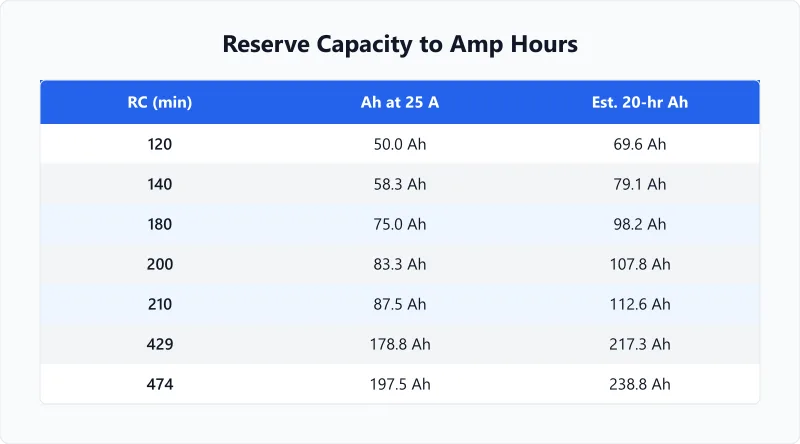
The table below is built from datasheets, not from a formula. Each row groups the captured batteries that share a BCI group size and prints what the manufacturer prints, beside what the calculator returns.
| BCI group | Printed RC at 25A | Capacity at 25A rate | Estimated 20-hour Ah | Printed 20-hour Ah |
|---|---|---|---|---|
| 34/24 AGM | 120 min | 50.0 Ah | 69.6 Ah | 55 Ah |
| Group 24 | 140 min | 58.3 Ah | 79.1 Ah | 90 Ah |
| Group 27 | 175-186 min | 72.9-77.5 Ah | 95.8-101.1 Ah | 80-115 Ah |
| Group 31 | 195-210 min | 81.3-87.5 Ah | 105.4-112.6 Ah | 105-130 Ah |
| 12V commercial | 429 min | 178.8 Ah | 217.3 Ah | 215 Ah |
| GC2 golf-car (6V) | 450-474 min | 187.5-197.5 Ah | 227.3-238.8 Ah | 232-235 Ah |
The Group 27 row is the one worth staring at. Six batteries whose reserve ratings fall within 11 minutes of each other carry 20-hour ratings from 80 Ah to 115 Ah, a 44% spread that no formula taking RC alone can resolve. Where a label prints a 20-hour rating, use it. The estimate is for labels that do not.
Where the 20-Hour Estimate Comes From
No BCI document prints a rule for turning reserve minutes into a 20-hour rating, and an earlier version of this page implied one existed. What manufacturers do print is the pair: on a single datasheet row, the reserve minutes at 25 amps and the 20-hour amp-hour rating. Fourteen such pairs, from five manufacturers, are what the second output is built on.
- Trojan 27TMX 175 min / 105 Ah; Lifeline GPL-27T 186 / 100
- Crown 24HDC 140 / 90; 27HDC 180 / 115; 31HDC 200 / 130; CR-215 429 / 215; CR-235 450 / 235
- U.S. Battery 2200 XC2 474 / 232
- Deka DP27 175 / 80; DC27 180 / 90; DC31DT 195 / 105; 8A27M 185 / 92; 8A31DTM 210 / 105; 9A34M 120 / 55
A least-squares straight line through those fourteen points gives Ah at the 20-hour rate = 12.2 + 0.478 x RC minutes. A power curve fitted the same way lands on a root-mean-square residual of 11.71% against the line's 11.70%, so the extra term buys nothing and the line is what the calculator uses. Nine of the fourteen batteries fall within 10% of that line and all fourteen within 21%, which is the band printed beside the estimate. Below 120 or above 474 reserve minutes the calculator says so, because no battery in the set sits there.
Two things this does not do. It does not model the Peukert effect; the line is fitted to what manufacturers measured, not derived from a discharge exponent. And it cannot separate a thin-plate starting battery from a heavy deep-cycle one, which is exactly what the Group 27 spread in the table above is showing you.
Worked Examples
Reading a Group 31 Label That Prints Both Numbers
Context
Crown's 31HDC datasheet prints 200 reserve minutes at 25 amps and, on the same row, a 130 Ah 20-hour rating. Run the reserve figure through the calculator and you can see exactly what each output is for.
Calculation
Capacity at the 25A rate: 200 minutes / 60 = 3.333 hours; 3.333 x 25 A = 83.3 Ah
Estimated 20-hour rating: 12.2 + 0.478 x 200 = 107.8 Ah, with a band of 85.2 to 130.4 Ah
Energy at the 25A rate: 83.3 Ah x 12 V = 1,000 Wh
Interpretation
Crown's printed 130 Ah sits at the top edge of the band, 20.6% above the fitted line. The 83.3 Ah figure is not wrong and not a bad estimate of the label; it is a different measurement, the charge this battery gives up when you pull 25 amps out of it. Plan a house bank on the 130 Ah and plan an alternator-failure reserve on the 83.3 Ah.
Takeaway
Once you have the right amp-hour figure, convert it to watt-hours before comparing packs at different voltages with our battery capacity calculator.
Is a Group 27 Enough for an 80 Ah RV House Load?
Context
You need at least 80 Ah for an overnight RV load and you are looking at a Deka DC27, a Group 27 heavy-duty deep cycle. Its datasheet prints 180 reserve minutes at 25 amps and a 90 Ah 20-hour rating.
Calculation
Capacity at the 25A rate: 180 / 60 = 3 hours; 3 x 25 A = 75.0 Ah
Estimated 20-hour rating: 12.2 + 0.478 x 180 = 98.2 Ah, band 77.6 to 118.9 Ah
Printed 20-hour rating: 90 Ah, which is 8.4% under the fitted line and inside the band
Interpretation
Judge this battery on RC alone and the 75 Ah figure says it misses your 80 Ah target. The manufacturer's own 20-hour rating says it clears it with 10 Ah to spare. The RC number is not measuring the thing you are sizing for, which is a slow overnight draw, so the 90 Ah is the number to plan on.
Takeaway
Turn that 90 Ah into real hours against your actual appliance list with our RV battery runtime calculator.
Frequently Asked Questions
Glossary
Reserve Capacity
The minutes a fully charged 12V battery can sustain a 25-amp draw at 80F before voltage drops below 10.5V. RC is a BCI standard designed to show how long a car's electrical system runs if the alternator fails.
Twenty-Hour Rate
The discharge rate behind the amp-hour number on most deep-cycle labels: the steady current a battery sustains for 20 hours before reaching its cutoff voltage. A 100 Ah battery at this rate delivers 5 amps for 20 hours. It is a far gentler test than the 25-amp reserve-capacity discharge, which is why the two ratings do not match.
Peukert Effect
The drop in delivered capacity as discharge current rises, pronounced in lead-acid chemistries. It is the physical reason a 25-amp test returns fewer amp-hours than a 20-hour test on the same battery. This calculator does not model it: the 20-hour estimate is fitted to manufacturers' published ratings rather than derived from a Peukert exponent.
Battery Group Size
A BCI standard specifying the physical dimensions, terminal type, and position of an automotive or marine battery. Group 24, 27, and 31 are common deep-cycle sizes. The group number does not indicate capacity — it is purely dimensional.
Need to size a starting battery by CCA instead? The cold cranking amps calculator handles that by engine size and climate.
Related calculators
Battery Capacity (Amp Hours) Calculator
Calculate battery capacity in amp-hours from watt-hours and voltage. Convert between Wh, Ah, and watts easily.
Battery
Cold Cranking Amps (CCA) Calculator
Size a starting battery from engine displacement and fuel type, using the original-equipment minimum CCA figures for cars and light trucks.
Battery
Marine Battery Runtime Calculator
Estimate trolling motor and boat electronics runtime from your marine battery. Built for anglers and boaters.
Battery
Watt Hours to Amp Hours Calculator
Convert watt-hours to amp-hours at any voltage. Use this to compare batteries rated in different units.
Battery
The two outputs answer two different questions. The 25-amp figure tells you what actually came out of the battery during the reserve-capacity test, and it is exact. The 20-hour figure is an estimate of what a deep-cycle label would say, with a band wide enough to be honest about how much two batteries of the same size can differ. Take the 20-hour number into your sizing work, then see what it buys in hours of real load with our battery runtime guide.
More Battery calculators
Browse all battery calculators — LiFePO4, lead-acid, AGM, and lithium-ion runtime, charge time, and capacity sizing.
Last updated:
Written and maintained by Dan Dadovic, Commercial Director at Ezoic Inc. & PhD Candidate in Information Sciences. He works professionally as Commercial Director at Ezoic Inc., leading revenue strategy across digital publishing.
Disclaimer: Calculator results are estimates based on theoretical formulas. Actual performance varies with temperature, battery age, load patterns, and equipment condition. For critical electrical work, consult a licensed electrician.
Methodology reviewed by Doc. dr. sc. Damir Topić, Assistant Professor, FERIT Osijek.