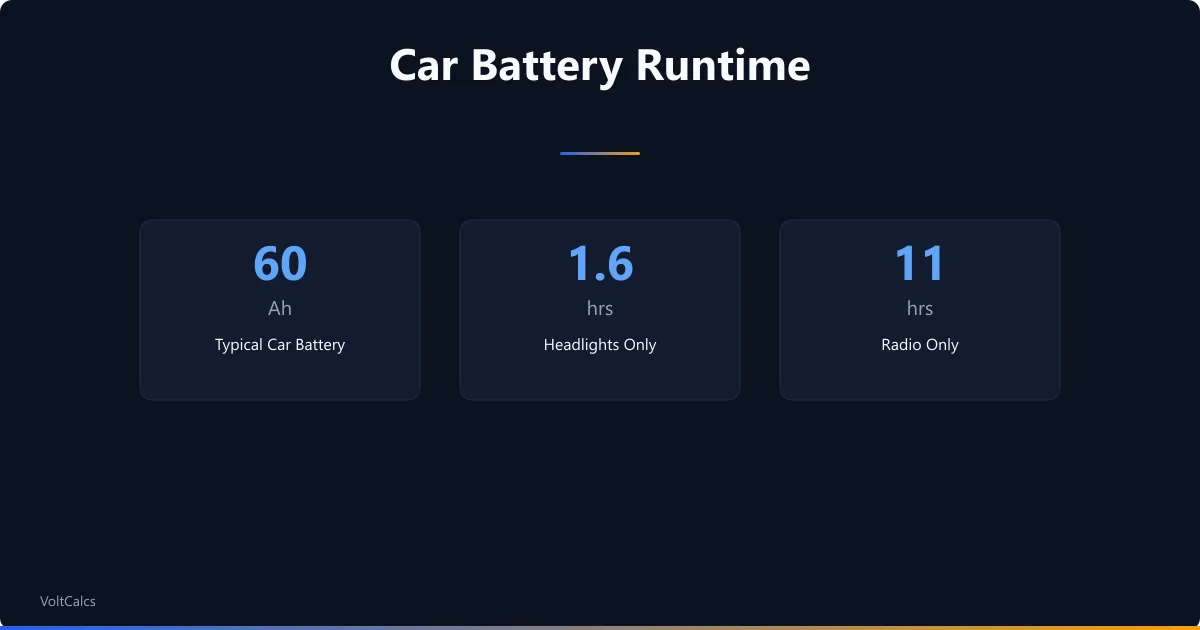
Why Car Batteries Are Not Built for Runtime
Car batteries (SLI — starting, lighting, ignition) pack many thin lead plates close together. That design maximises the surface area behind the burst of current that turns the starter, the job measured by the cold cranking amps a starter battery delivers, and it leaves the same plates fragile under a long, slow discharge.
Discover Battery prints the design limits as plain numbers. Regular flooded starting batteries "are designed for discharges of less than 3%" of capacity. Enhanced flooded start-stop batteries are designed for up to 17.5%. High-cycle anti-idle batteries, the ones built for running house loads with the engine off, are designed for up to 30%. A plain car battery is the first of those three, so running accessories from it is a one-off rather than a habit. Our depth of discharge guide explains why the same percentage costs SLI, AGM and LiFePO4 chemistries such different amounts of life.
How deep is too deep? EnerSys prints the line for its ODYSSEY batteries: at 12.0 volts, which its manual calls 35% state of charge, the battery "should be recharged immediately to avoid permanent battery damage". That is 65% depth of discharge. The calculator defaults to 30%, flags every setting past 3%, and marks anything past 65% as damage territory. If key-off power is part of how you use the vehicle, an AGM battery sized for cycling on its own isolator is the fix, not a deeper draw from the starter.
Common Car Accessory Power Draws
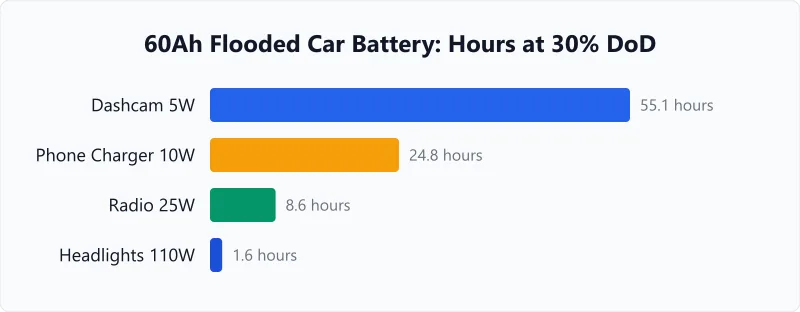
| Accessory | Worked at | Runtime on 60Ah flooded (30% DoD) |
|---|---|---|
| Dome light | 10W | 24.8 hours |
| Radio (engine off) | 15-25W | 8.6-15.5 hours |
| Headlights (halogen) | 110-130W | 1.3-1.6 hours |
| Headlights (LED) | 30-50W | 3.9-7.0 hours |
| Phone charger | 10-18W | 12.6-24.8 hours |
| Dash cam (always-on) | 3-5W | 55-99 hours |
| Heated seats | 40-60W per seat | 3.1-5.0 hours |
| 12V air compressor | 120-180W | 0.9-1.4 hours |
| Car camping (fan + lights + charger) | 50-80W | 2.3-3.9 hours |
The wattages are the figures worked, not measurements of your car: read yours off the nameplate or measure it. The runtimes are this calculator's own output at the page defaults, a 60Ah flooded battery at 30% depth of discharge with no inverter in the path. The dash cam rows draw less than 8W, which is slower than the slowest discharge Trojan prints for a flooded battery, so those two are extrapolations. A lead-acid battery also loses charge sitting idle, so a long runtime at a tiny load is not a shelf-life figure.
The most common way people flatten a car battery is leaving the headlights on. At 120W, halogen headlights take a 60Ah battery to 30% depth in about 1 hour 25 minutes. By the time you come back, the starter may not turn.
How the calculator gets there: the energy a lead-acid battery gives up falls as you draw it faster, so instead of assuming the label amp-hours are available at any current it applies a discharge-rate correction fitted to the tables Trojan, Lifeline and Victron print for their own batteries. Those are deep-cycle products, which is worth saying plainly. The fit lands within about 10% of Trojan's printed flooded points and about 6% of Lifeline's AGM points, and checked against the constant-power table EnerSys prints for a 12V automotive AGM it sits within about 5% from the 20-hour rate down to the 1-hour rate. Faster than that it turns optimistic, which is why a heavy load gets a warning instead of a confident number.
Worked Examples
How Long Can You Run a Car Stereo Without the Engine?
Context
Your car battery is a 60Ah flooded unit. The stereo draws 50W. You hold the draw to 30% depth of discharge, the figure Discover prints for batteries built to run key-off loads.
Calculation
Current: 50W / 12V = 4.17A, which is 4.17 / 60Ah = a 0.069C discharge.
The fitted flooded discharge curve gives 12.9 hours to a full discharge at that rate; 30% of it is 3.87 hours.
Interpretation
About 3 hours 52 minutes of stereo, and 194Wh out of the battery. On a cold morning even 30% may not leave enough cranking current, because a lead-acid battery gives up less of everything as it gets colder.
Takeaway
Car batteries are designed for starting, not deep discharge. For extended accessory use, add a dedicated deep cycle battery wired separately from the starting battery.
Parasitic Draw Draining a Battery Over Two Weeks
Context
You park your car at the airport for 14 days. Factory parasitic draw (alarm, computer memory, clock) is about 25 milliamps (0.3W). Your battery is 60Ah.
Calculation
Energy used: 0.3W x 24 hrs x 14 days = 100.8 Wh
Ah used: 0.025A x 336 hours = 8.4 Ah
That is 14% of the 60Ah capacity, and more than four times the 3% Discover prints as the regular limit for a flooded starting battery, in one 14-day sitting.
Interpretation
A healthy battery handles 14 days easily. But an old battery at 70% health only has 42 Ah effective, and 8.4 Ah represents 20% — it might not start reliably in cold weather.
Takeaway
If your car struggles to start after sitting, the issue is likely battery health, not parasitic draw. To check whether your battery capacity is adequate, see our battery voltage percentage calculator.
Frequently Asked Questions
Glossary
Parasitic Draw
The current a vehicle's electronics keep drawing with the engine off. OPTIMA prints that a 25-milliamp draw is acceptable and that anything over 100 milliamps indicates an electrical issue, commonly a stuck relay, an aftermarket accessory or a failing module. At 12V that is 0.3W of healthy standby draw against 1.2W that needs chasing down.
Starting Battery vs Deep Cycle
Car batteries (SLI type) deliver high current for short bursts to start the engine. Discover prints the difference in one figure: regular flooded starting batteries are designed for discharges of less than 3% of capacity, while the high-cycle anti-idle batteries built for key-off loads are designed for up to 30%. Pull a starting battery deeper than it was designed for and the thin plates shed material, which is why this calculator flags every setting past 3%.
Reserve Capacity
The minutes a car battery can deliver 25 amps before voltage drops below 10.5V. This indicates how long accessories can run with the engine off. A higher RC means more headroom for situations like tailgating or emergency lighting.
Check the amps draw calculator to convert any accessory wattage to amps for fuse sizing.
Related calculators
Cold Cranking Amps (CCA) Calculator
Size a starting battery from engine displacement and fuel type, using the original-equipment minimum CCA figures for cars and light trucks.
Battery
Battery Voltage to Percentage Calculator
Turn a resting multimeter reading into a state of charge percentage for flooded lead-acid and AGM batteries, from the makers' own printed voltage tables.
Battery
Reserve Capacity to Amp Hours
Convert battery reserve capacity minutes into amp-hours two ways: the exact capacity at the 25 amp test rate and an estimated 20-hour rating.
Battery
12V Battery Runtime Calculator
Calculate how long a 12 volt battery lasts under any load, with flooded, AGM, gel and LiFePO4 each corrected for discharge rate.
Battery
Treat the figure above as a budget for one occasion. Discover puts a plain flooded starting battery under 3% depth in regular use, so a 30% draw is something you do when you have to and then recharge. If running power with the engine off is part of how you use the vehicle, the answer is a second battery on its own isolator: tally what it has to carry with the electrical load calculator before you buy one.
More Battery calculators
Browse all battery calculators — LiFePO4, lead-acid, AGM, and lithium-ion runtime, charge time, and capacity sizing.
Last updated:
Written and maintained by Dan Dadovic, Commercial Director at Ezoic Inc. & PhD Candidate in Information Sciences. He works professionally as Commercial Director at Ezoic Inc., leading revenue strategy across digital publishing.
Disclaimer: Calculator results are estimates based on theoretical formulas. Actual performance varies with temperature, battery age, load patterns, and equipment condition. For critical electrical work, consult a licensed electrician.
Methodology reviewed by Doc. dr. sc. Damir Topić, Assistant Professor, FERIT Osijek.