What Size Inverter Do I Need?
Last updated:
9 min read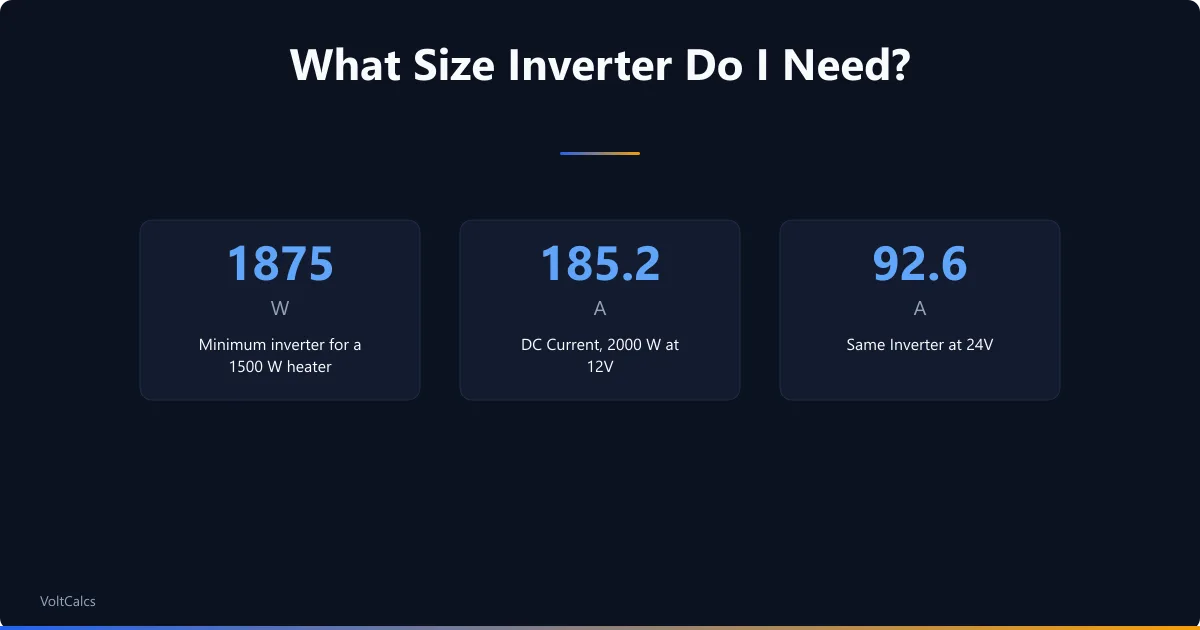
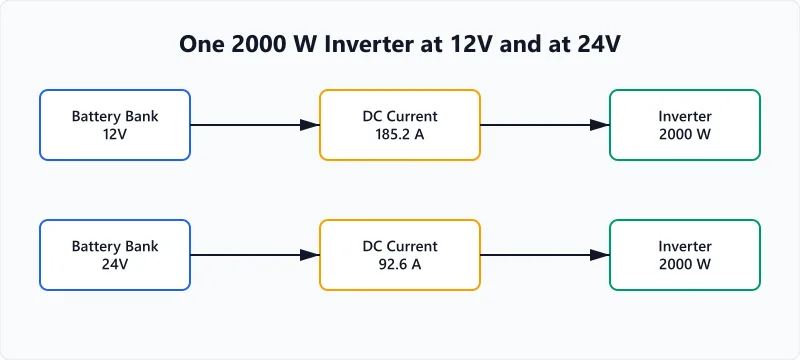
Size an inverter from two figures on your own appliance labels: the watts of everything that runs at the same time, and the starting current of the largest motor or compressor in that set. The first sets the continuous rating you buy. For the second, multiply the starting current by the supply voltage on a single-phase motor: those starting volt-amperes, on top of whatever else is running when it starts, are the figure to check against the inverter's peak or surge rating as the maker states it. Then check the current that inverter draws on the battery side, since that is the current you size the cable for: in the site's inverter cable size calculator, a 2000 W inverter at 12 V draws 185.2 A from the bank at 90% efficiency, and the same inverter at 24 V draws 92.6 A.
The Ratings Printed on the Box
One inverter's datasheet lists its output more than one way. Victron's datasheet for its Inverter Smart range prints the 12/1600 model's continuous output at 25 °C as 1600 VA on one line and 1300 W on the next, then 1200 W at 40 °C and 800 W at 65 °C. The Inverter Smart 12/1600's peak power is 3000 W. If your appliance labels give watts, the W lines at 25, 40 and 65 °C are the ones in the same unit.
Victron's manual for its Phoenix Inverter 750 separates continuous and short-term output with three labels: a continuous output power of 750 W, a maximum output power of 800 W for 3 minutes, and a surge rating of 1400 W. The manual prints a time only against the 800 W figure. For an overload, it lists the load LED bar flashing and says to reduce the load.
Two more lines matter for a battery system: efficiency and zero-load draw. The Inverter Smart datasheet prints a maximum efficiency of 92% for the 12 V 1600 VA model. The Phoenix 750 manual prints full-load efficiency from 89.0% to 94.0% across its six versions. The zero-load line is what the inverter draws with nothing plugged in: 8 W for the 12 V Inverter Smart 1600, falling to 0.6 W in its ECO mode. The Phoenix manual prints a no-load current draw of 1.25 A for the 120 V version of the 12/750 and 1.20 A for the 220/230/240 V version.
Sizing the Continuous Rating from Your Loads
- List what runs at the same time. Count only the loads that are on together at your busiest moment. A fridge cycling while a kettle boils and a laptop charges adds up to more than the fridge alone at night.
- Read each label. Take the rated watts, or the volts and amps, from the plate or sticker on each appliance, and use those figures rather than a generic table. The amps draw calculator turns watts into current for single-phase and three-phase loads, with a power factor input: a 1500 W single-phase load at 120 V draws 12.5 A.
- Add them up. The total is the continuous watts your inverter has to carry.
- Add a margin. The site's 1500 W heater sizing tool adds 25% to the heater's continuous load before it names an inverter: for a 1500 W heater it returns a minimum inverter of 1875 W, and this guide uses that margin as its example.
- Check the temperature line. If the inverter will live in a hot locker or an engine bay, size against the derated line for that temperature above, not the 25 °C one.
Victron's book Energy Unlimited starts from the other end for a battery-assisted AC concept: the first question, it says, is not "what is the maximum AC power to be expected?" but "what is the daily electric energy need?", because the daily energy need determines the rating of the source of electric power. The steps above size the inverter alone. The bank behind it is sized from the energy your loads use over the hours they run, and the worked example below does that sum for one hour of a 1500 W load.
Motors, Compressors and the Surge Rating
Motors are the loads Energy Unlimited names when it says an inverter has to be oversized. Energy Unlimited gives the example of a small diving compressor driven by an electric motor of around 3 kW whose start-up current is about 10 times the rated current, enough to trip the shore power circuit breaker in a harbor, so that a diesel generator has to be oversized to start it. It then widens the point: electric motors rated in the kilowatt range have very high inrush currents, and an inverter or diesel generator has to be oversized to run them, with pumps, air conditioning and the compressor as its examples.
That ten times belongs to the compressor motor in Energy Unlimited's example. Find your own motor's starting current on its nameplate or by measuring it; the site's locked rotor amps guide covers what that figure is. Turn it into starting volt-amperes as the opening of this guide does, and compare them with the peak or surge figure as the maker states it, in watts on both Victron documents above. A motor's starting power factor is below one, so the volt-amperes overstate the watts: the comparison errs on the safe side. If the start lands above that figure, the choices are a larger inverter or a change on the motor side: Energy Unlimited's answer for its compressor is a three-phase motor driven through a variable frequency drive, which the book says eliminates the start-up surge.
A Worked Example: 1500 W of Loads on a Battery Bank
Take a system whose loads add up to 1500 W when everything you want is on together, with nothing in that set that starts hard. Each figure below is the output of a VoltCalcs calculator at the inputs stated.
The inverter. With the heater tool's 25% margin, 1500 W of continuous load calls for an inverter of at least 1875 W, and a 2000 W model clears that.
The battery current and capacity. The battery size for inverter calculator at 1500 W, 1 hour, 12 V, LiFePO4, 80% depth of discharge and 90% inverter efficiency returns 163 Ah, a 2.1 kWh bank and a battery current of 130 A. Run again at 24 V with the other inputs unchanged, it returns 81 Ah, the same 2.1 kWh, and 65 A.
The cable. The inverter cable size calculator takes the inverter's rating, 2000 W here, rather than the load. At 2000 W, 12 V, 6 ft one way, a 3% maximum drop, 90% efficiency, continuous duty and inverter DC terminals not marked for 75 °C, it returns a DC current of 185.2 A and a gauge larger than 4/0 AWG, the largest single conductor it sizes. Its text says to use parallel conductors as the NEC's rule for conductors in parallel allows, or step up to a higher system voltage, and to have a licensed electrician verify the design. At 24 V with the same inputs it returns 92.6 A and 1/0 AWG.
| Figure (calculator) | 12 V bank | 24 V bank |
|---|---|---|
| Battery current for the 1500 W load (battery size for inverter calculator) | 130 A | 65 A |
| Battery capacity for 1 hour (battery size for inverter calculator) | 163 Ah | 81 Ah |
| Bank energy, total (battery size for inverter calculator) | 2.1 kWh | 2.1 kWh |
| DC current of the 2000 W inverter (inverter cable size calculator) | 185.2 A | 92.6 A |
| Cable gauge at 6 ft one way (inverter cable size calculator) | Larger than 4/0 AWG | 1/0 AWG |
Read across a row to see what the higher bank voltage does to each figure. The battery size for inverter calculator works its rows at LiFePO4's printed nominal voltage (12.8 V and 25.6 V), and the cable calculator works at the inverter's 12 V and 24 V input.
The DC Side: Current, Cable and Fuse
On the DC side, the same watts arrive at a lower voltage. Between a 120 V load and a 12 V bank the voltage falls to a tenth, so the current is ten times higher: the amps draw calculator puts 1500 W at 12 V at 125 A before inverter losses. The battery size for inverter calculator's 130 A for the same load comes from a different sum: it divides by the 90% inverter efficiency and, as its help text says, sizes the LiFePO4 bank at its printed 12.8 V nominal rather than 12 V.
The cable calculator's own text says the inverter maker's cable and fuse table governs where it prints a larger cable. The Phoenix 750 manual recommends #4 AWG wire and a 100 A inline fuse for its 12/750 model and says the battery cables should be as short as possible, ideally less than 10 feet (3 meters). The inverter cable sizing guide works through the calculator's method step by step.
The battery size for inverter calculator's note says the bank has to deliver its stated amps continuously, that every battery in it has a rating for that, and that only batteries wired in parallel share the current. Check your battery's continuous discharge figure against the amps the calculator returns before you buy the inverter.
What 24 V or 48 V Changes
The cable calculator's own text gives the rule: the same inverter at twice the voltage draws half the current, and when a 12 V cable runs past the largest single conductor it sizes, raising the voltage is usually the better fix. In the worked example the 2000 W inverter needs more than a single 4/0 AWG conductor at 12 V, and 1/0 AWG at 24 V. The battery current halves with it, as the table shows.
Both Victron documents print a higher efficiency at 24 V than at 12 V. The Inverter Smart prints maximum efficiency for its 1600 VA model as 92% at 12 V and 94% at 24 V and 48 V, and the Phoenix 750 manual's full-load efficiency line rises from the 12 V model to the 48 V model within each output voltage version.
If you are sizing a bank from scratch rather than adding an inverter to one you already own, the RV battery sizing guide works through the load audit and the chemistry choice for a bank before you pick the inverter that sits on it.
Heat, Idle Draw and Daily Energy
The Inverter Smart datasheet prints an operating temperature range of -40 to +65 °C with fan assisted cooling, and its continuous output lines above fall as the temperature rises. In a locker that gets hot in summer, those lower W lines are the ratings that apply, and they are what the last sizing step above checks your loads against.
Multiply the zero-load draw by the hours a day you leave the inverter switched on, loads or not. If the draw is printed in amps, as in the Phoenix manual, also multiply by the battery's voltage to turn the amp-hours into watt-hours. Add those watt-hours to your daily energy sum next to the appliances it runs.
Energy Unlimited notes that because inverter efficiencies today are higher than 90%, it ignores inverter losses in its energy consumption calculations. The battery size for inverter calculator keeps the efficiency term in: it divides by 0.9 at its default 90% efficiency, so the bank it returns comes out larger than a sum that ignores the inverter. Run your own load and hours through it, with your inverter's printed efficiency in place of the 90% default.
Frequently Asked Questions
Written and maintained by Dan Dadovic, Commercial Director at Ezoic Inc. & PhD Candidate in Information Sciences. He works professionally as Commercial Director at Ezoic Inc., leading revenue strategy across digital publishing.
Disclaimer: Calculator results are estimates based on theoretical formulas. Actual performance varies with temperature, battery age, load patterns, and equipment condition. For critical electrical work, consult a licensed electrician.
Methodology reviewed by Doc. dr. sc. Damir Topić, Assistant Professor, FERIT Osijek.