kVA vs kW: The Real Difference and When It Affects You
Last updated:
7 min read
Our kVA to amps calculator converts apparent power to current for single-phase and three-phase systems. kVA measures apparent power — the total electrical load on a circuit including both useful work and reactive losses. kW measures real power — only the portion that does actual work. In a perfect world they would be equal. In real electrical systems, they are not, and the gap between them determines whether your generator can handle your loads, whether your UPS lasts as long as promised, and whether your transformer overheats.
This guide explains the concept so you can make sense of the ratings on generators, UPS units, transformers, and other equipment where kVA and kW appear side by side.
Real Power, Apparent Power, and the Power Triangle
Electrical loads fall into three categories: resistive, inductive, and capacitive. A resistive load (like a space heater or incandescent bulb) converts all incoming electrical energy to useful work (heat, light). For resistive loads, kVA equals kW.
Inductive loads (motors, transformers, fluorescent ballasts) and capacitive loads create a phase shift between voltage and current. Part of the current flows back and forth without doing useful work — this is called reactive power, measured in kVAR. The total current flowing through the wires is higher than what the real power alone would require.
The power triangle in practice
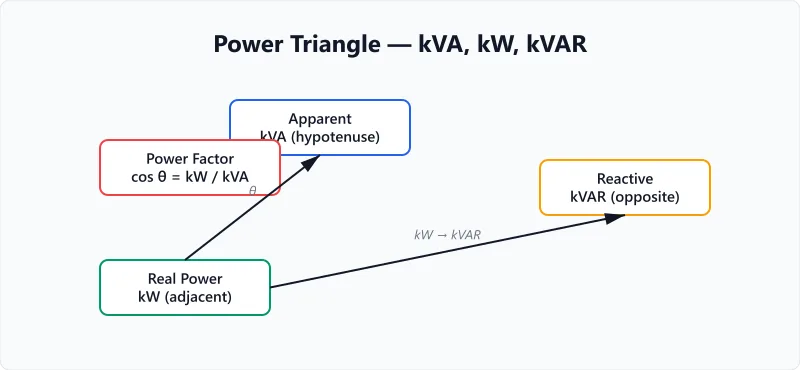
Imagine a 10 kVA load with a power factor of 0.80. The power triangle breaks down as:
Apparent power (hypotenuse): 10 kVA — this is the total electrical demand. Your generator, transformer, and wiring must be rated for this value.
Real power (adjacent side): 10 kVA x 0.80 = 8 kW — this is the useful work being done. This is what your electricity meter bills you for (in most residential settings).
Reactive power (opposite side): 10 kVA x 0.60 = 6 kVAR — this is the current that flows back and forth without producing useful work. It does not consume energy, but it does load your wiring and equipment.
The relationship: kVA = kW / power factor. Or equivalently: kW = kVA x power factor. The power factor (PF) is always between 0 and 1. A PF of 1.0 means kVA = kW (purely resistive load). A PF of 0.70 means you need 43% more apparent power capacity (kVA) than your real power demand (kW).
Where the kVA vs kW Gap Matters
The distinction between kVA and kW creates real-world sizing problems in three common situations.
Generator sizing. Generators are rated in both kW and kVA. If you are considering a propane-powered generator, our propane generator runtime guide covers fuel consumption at different load percentages. A generator rated at "10 kW / 12.5 kVA" can deliver 10 kW of real power to resistive loads, or serve up to 12.5 kVA of apparent power when the loads have a poor power factor. If your loads total 10 kW but have a power factor of 0.75, you need 10 / 0.75 = 13.3 kVA — the 12.5 kVA generator is undersized. You either need a bigger generator or must improve the power factor of your loads.
UPS runtime. A UPS rated at "3 kVA / 2.4 kW" can deliver 2,400 watts of real power (assuming a 0.80 PF load). If your load draws 2,400 watts at unity PF, the UPS runs it fine. If your load draws 2,400 watts at 0.70 PF, the apparent power is 3,429 VA — exceeding the 3,000 VA rating. The UPS may shut down or refuse to power the load even though the watt demand seems within spec. Our electrical load calculator helps you total real and apparent power separately.
Transformer loading. Transformers are rated in kVA because they must handle the full apparent power regardless of power factor. A 50 kVA transformer serving a 40 kW load at 0.85 PF sees 40 / 0.85 = 47 kVA — within rating. Drop the power factor to 0.70 and the same 40 kW load demands 57 kVA — overloading the transformer. The transformer fusing calculator accounts for this when sizing protection, and our guide to NEC 450.3 fuse sizing works through the percentages step by step.
Common Equipment: kVA and kW Ratings
| Equipment | Typical Rating | Assumed PF | What You Actually Get |
|---|---|---|---|
| Portable generator (residential) | 7.5 kW / 9.4 kVA | 0.80 | 7.5 kW to resistive loads |
| Standby generator | 22 kW / 22 kVA | 1.0 | Rated at unity PF — derate for motors |
| UPS (server room) | 3 kVA / 2.7 kW | 0.90 | 2.7 kW of real power to IT loads |
| UPS (older models) | 3 kVA / 2.1 kW | 0.70 | 2.1 kW — older UPS assume worse PF |
| Distribution transformer | 50 kVA | Variable | 50 kW at PF=1.0, 40 kW at PF=0.80 |
| Welding machine | 5 kVA | 0.50-0.70 | 2.5-3.5 kW depending on type |
Notice that newer UPS units assume higher power factors (0.90-1.0) because modern computer power supplies with active power factor correction draw current much more efficiently than older designs. If you are replacing an old UPS, a unit with the same kVA rating but higher PF ratio delivers more usable watts.
Practical Guidance
For residential loads: most household appliances have a power factor between 0.85 and 1.0. Resistive loads (heaters, toasters, incandescent bulbs) are 1.0. Motor loads (fridge compressor, AC, washing machine) are typically 0.80-0.90 with modern designs. For rough residential sizing, assuming PF = 0.85 is safe.
For workshop and industrial loads: older motors, welders, and inductive loads can have power factors as low as 0.50-0.70. Size generators and transformers by kVA, not kW, when these loads are present. If the total kW demand seems within rating but the generator keeps bogging down, poor power factor is likely the culprit.
Power factor correction. Adding capacitors in parallel with inductive loads can raise the power factor toward 1.0, reducing the kVA demand without changing the kW demand. The IEEE power engineering standards define power factor measurement and correction methods used across the industry.
This is standard practice in commercial and industrial settings where utilities charge a penalty for poor power factor. Residential customers in the US are typically billed only for kW (real power), so power factor correction has no direct financial benefit at home — but it still matters for equipment sizing. The NEMA MG 1 motor standard lists typical power factors for different motor sizes and types, which is useful when estimating loads without nameplate data. Cited to NEMA MG 1. The standard text is not freely available to link; confirm against the current edition before acting.
If you are sizing circuits for motors where the kVA/kW distinction hits hardest, our horsepower to watts guide covers the HP-to-amps conversion chain, and the motor FLA guide explains how full-load amps connect motor ratings to real electrical demand.
When in doubt, use kVA. Equipment rated in kVA must be sized for the worst-case load. To understand how your electricity bill accounts for these different power measurements, the key distinction is that residential meters typically bill only for real power (kW), not apparent power (kVA). If you cannot determine the power factor of your loads, size equipment in kVA using the actual current measurement (Amps x Volts = VA). This guarantees the equipment is not overloaded regardless of power factor. You might oversize slightly compared to a kW-based calculation, but oversizing is always safer than undersizing.
Frequently Asked Questions
Written and maintained by Dan Dadovic, Commercial Director at Ezoic Inc. & PhD Candidate in Information Sciences. He works professionally as Commercial Director at Ezoic Inc., leading revenue strategy across digital publishing.
Disclaimer: Calculator results are estimates based on theoretical formulas. Actual performance varies with temperature, battery age, load patterns, and equipment condition. For critical electrical work, consult a licensed electrician.
Methodology reviewed by Doc. dr. sc. Danijel Jerković-Štil, Assistant Professor, FERIT Osijek.