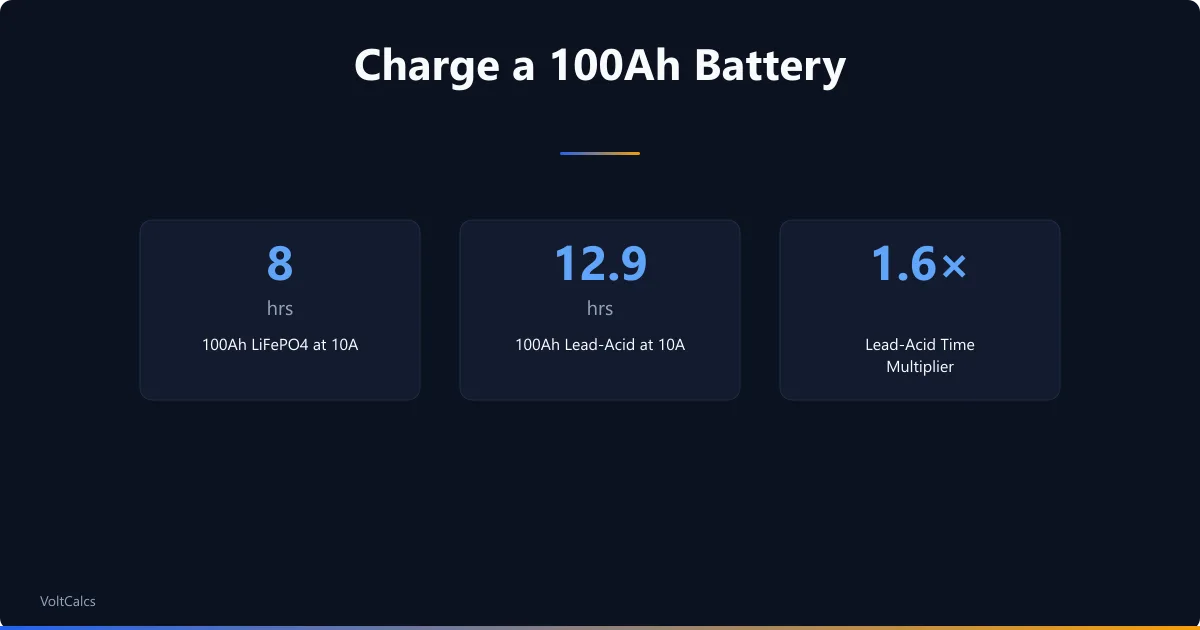
Charge Time for 100Ah Battery by Source
| Charging Source | Typical Amps | Time from 20% to 100% (LiFePO4) | Time from 20% to 100% (Lead-Acid) |
|---|---|---|---|
| 5A trickle charger | 5A | 16 hours | 25.7 hours |
| 10A smart charger | 10A | 8 hours | 12.9 hours |
| 20A battery charger | 20A | 4 hours | 6.4 hours |
| 40A DC-DC charger | 40A | 2 hours | 3.2 hours (above the printed lead-acid limit) |
| 100W solar panel | 5.3A | 15.1 hours (3-4 days) | 24.3 hours (5-6 days) |
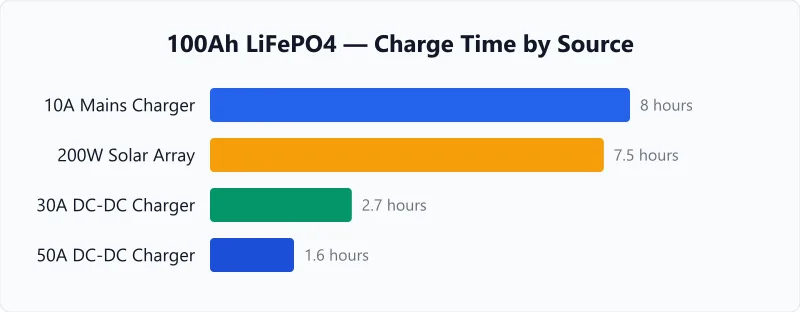
| 200W solar panel | 10.6A | 7.5 hours (1.5-2 days) | 12.1 hours (2.5-3 days) |
| 400W solar array | 21.2A | 3.8 hours (1 day) | 6.1 hours (1.5 days) |
| DC-DC charger from the alternator | 30-50A | 1.6-2.7 hours | 2.6-4.3 hours (50A is above the printed limit) |
Solar rows use the 5.29A per 100W panel that Renogy prints in its own sizing example, and assume 4-5 peak sun hours a day, which is why they carry a figure in days as well as hours. The lead-acid column is longer for one reason: its absorption stage. Bulk charging stops at about 80% state of charge on lead-acid, and the last fifth goes in at a falling current that takes roughly as long again. LiFePO4 holds full current to 95%, so its total is close to amp-hours divided by amps. Two cells above sit past the charge rate East Penn prints as a maximum for 12V lead-acid, 30% of the 20-hour rating or 30A here: the 40A row and the 50A end of the DC-DC row. They are shown because people charge that way, not because the battery maker allows it. For a battery that is not 100Ah, our battery charge time calculator takes any capacity.
Example: Charging a 100Ah LiFePO4 with Solar
You have a 200W solar panel and an MPPT charge controller on a 100Ah 12V LiFePO4 that is 80% depleted, so 80Ah to put back. Renogy prints 5.29A per 100W panel in its own sizing example, which makes 200W of panel about 10.6A into the battery.
Bulk charging runs to the 95% state of charge Victron prints as the lithium endpoint: 75Ah at 10.6A is 7 hours 5 minutes. The last 5Ah follows at the same current, another 28 minutes. Victron puts the lithium absorption stage at "typically less than 30 minutes" and Battle Born prints 30 minutes per 100Ah bank, so that tail lands where both makers say it should. Total: 7 hours 33 minutes of full sun.
Full sun is not a full day. At 5 peak sun hours the panel returns 10.6 x 5 = 53Ah, so the 80Ah deficit takes 1.5 days. On a cloudy day with 3 peak sun hours you get 31.8Ah back. That is 40% of the deficit and leaves the battery at about 52% state of charge, finishing the next morning.
Add a second 100W panel and the current goes to roughly 15.9A, which pulls the charge down to 5 hours 2 minutes. One good day covers it with nothing to spare.
Worked Examples
Charging 100Ah LiFePO4 from a 50A Alternator-Powered Charger
Context
Your vehicle alternator feeds a 50A DC-DC charger connected to a 100Ah LiFePO4 at 80% DoD. You want to know how long to drive to fully recharge.
Calculation
Amp-hours to replace: 100 x 0.80 = 80 Ah
Bulk runs to the 95% endpoint: 100 x (80 - 5) / 100 = 75 Ah at 50A = 1.5 hours
Absorption returns the last 5 Ah at the same current: 5 / 50 = 0.1 hours
Total: 1.5 + 0.1 = 1.6 hours, or 1 hour 36 minutes
Interpretation
Six minutes of that is the absorption tail. 50A on a 100Ah battery is 0.5C, the rate Victron recommends for its own lithium. The same charge in lead-acid takes 2 hours 34 minutes, and 50A would be well past the 30A ceiling East Penn prints for it.
Takeaway
For trips where you also charge from solar while parked, figure out what size panel you need with our solar panel size calculator to model daily charging capacity.
How Long Does a Single 100W Solar Panel Take?
Context
A 100W solar panel delivers about 5.3A through an MPPT controller, the figure Renogy prints per 100W panel. Your 100Ah LiFePO4 is at 20% remaining, so 80% depth of discharge, and you get 5 peak sun hours a day.
Calculation
Amp-hours to replace: 80 Ah
Bulk to the 95% endpoint: 75 / 5.3 = 14.2 hours
Absorption, the last 5 Ah: 5 / 5.3 = 0.9 hours
Total sun needed: 15.1 hours
Days at 5 peak sun hours: 15.1 / 5 = 3 days
Interpretation
Three clear days from one panel, and that is the lithium answer. The same battery in lead-acid needs 24.3 hours of sun, closer to five days. One 100W panel suits a light daily draw of 20-25Ah, not a bank you take down to 80% depth.
Takeaway
For faster recharging, size a larger solar array. Our solar panel and battery sizing calculator determines exactly how many panels match your daily energy use.
Frequently Asked Questions
Glossary
DC-DC Charger
A device that charges a house battery from the vehicle alternator while keeping the two systems separate, regulating the alternator output to the profile the house chemistry needs. Printed ratings sit in the tens of amps: Victron lists 30A for the Orion-Tr Smart 12/12-30A and Renogy lists 50A for the DCC50S. On a 100Ah battery that is a 0.3C to 0.5C charge, which is the lead-acid ceiling at one end and a comfortable lithium rate at the other.
MPPT Controller
A Maximum Power Point Tracking charge controller converts the panel voltage down to the battery voltage instead of clamping the panel to it, so more of the panel output reaches the battery. The makers print their own figures rather than one agreed number: Victron works an example where a PWM controller harvests 19% less from the same panel, and Morningstar puts the MPPT gain at 10-15% of charging capability. Treat those two as the numbers on record.
Charge Acceptance
The rate at which a battery will take energy from a charger. LiFePO4 holds full current to about 95% state of charge, which is where Victron says its bulk stage ends. A lead-acid battery is at roughly 80% when bulk ends, and the last fifth goes in at a falling current. That is why the second half of a lead-acid charge clock belongs to the absorption stage rather than to the amps on the charger label.
Sizing your solar array to fully recharge daily? Our solar battery charge time calculator models panel output throughout the day.
Related calculators
Battery Charge Time Calculator
Calculate how long a battery takes to charge from capacity, charger amps, and chemistry. Returns the bulk stage and the absorption stage separately.
Battery
Solar Battery Charge Time Calculator
Calculate how long your solar panels take to charge your battery bank. Accounts for sun hours, system voltage, and real-world losses.
Solar
Battery Charge and Discharge Calculator
Work out both halves of one battery cycle. Pick the chemistry and the tool follows the discharge and charge behaviour the makers actually print.
Battery
Battery Capacity (Amp Hours) Calculator
Calculate battery capacity in amp-hours from watt-hours and voltage. Convert between Wh, Ah, and watts easily.
Battery
Charging a 100Ah battery runs from 1 hour 36 minutes on a 50A DC-DC charger to the better part of a week on one solar panel in poor weather. Two things set that spread: the amps your source can actually deliver, and whether the last fifth of the charge goes in at full current or at a taper. Size the source against the amp-hours you take out on a normal day, then check it against a bad one. Our LiFePO4 vs lead-acid comparison covers both halves of that cycle, charge and discharge.
More Battery calculators
Browse all battery calculators — LiFePO4, lead-acid, AGM, and lithium-ion runtime, charge time, and capacity sizing.
Last updated:
Written and maintained by Dan Dadovic, Commercial Director at Ezoic Inc. & PhD Candidate in Information Sciences. He works professionally as Commercial Director at Ezoic Inc., leading revenue strategy across digital publishing.
Disclaimer: Calculator results are estimates based on theoretical formulas. Actual performance varies with temperature, battery age, load patterns, and equipment condition. For critical electrical work, consult a licensed electrician.
Methodology reviewed by Doc. dr. sc. Damir Topić, Assistant Professor, FERIT Osijek.