What Size Battery Charger Do I Need?
Last updated:
9 min read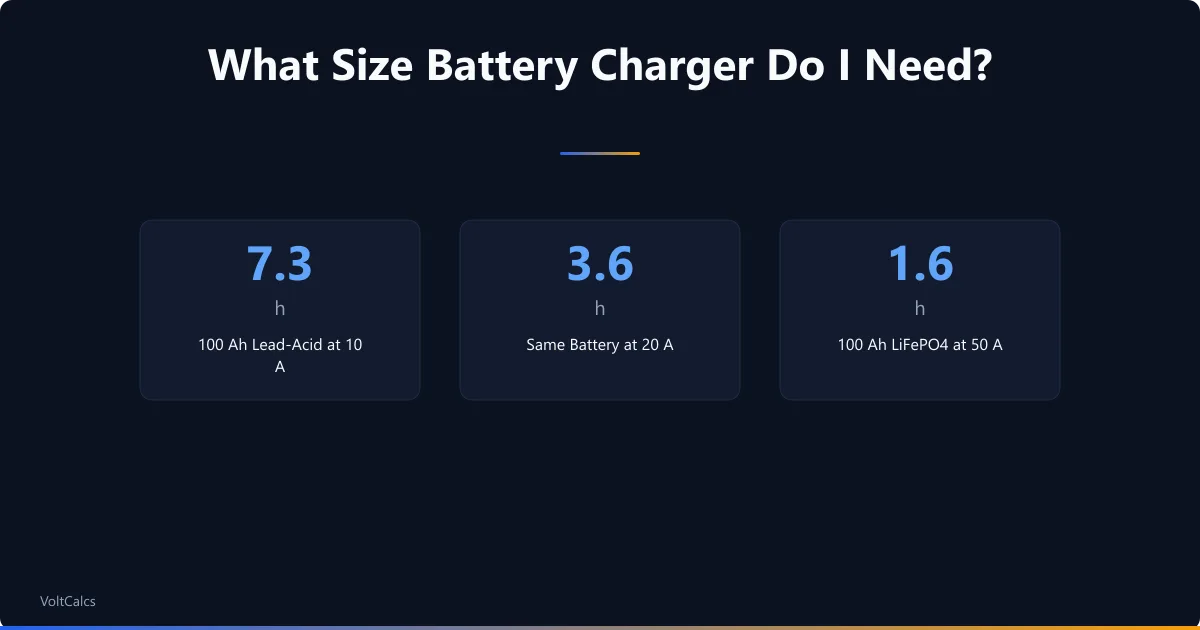
Size a battery charger from the battery's amp-hour rating and the charge rate its maker prints for that chemistry. Trojan's battery maintenance page says that when you select a charger, the charge rate should be between 10% and 13% of the battery's 20-hour amp-hour capacity. On Trojan's rule, a battery rated 100 Ah calls for a charger of 10 A to 13 A.
For lithium, Victron's Lithium Battery Smart manual writes the rate as a C-rate, where C is the battery's amp-hour rating read as amps. Victron recommends a charging current of 0.5C and does the arithmetic itself: 0.5C for a 100 Ah battery corresponds to 50 A.
The Charge Current Each Maker Prints
Victron prints two very different currents for the same battery. Victron's datasheet for its lithium iron phosphate Smart batteries gives its 12.8 V, 100 Ah model a recommended charge current of 50 A and a maximum charge current of 200 A. The Victron manual notes that the battery can be charged with a much higher current, and says: "we recommend a charging current of 0.5C, which will fully recharge a completely empty battery in 2 hours."
Trojan's maintenance page prints its maximum charge current as a share of capacity: 20% of C20 for its AGM line and 13% of C20 for its Solar Premium and Signature lines. The same page says chargers with lower ratings can be used. The 10% to 13% selection rate is the figure Trojan gives for choosing a charger. The maximum is the most current the page allows on each line.
From the Printed Rate to a Charger Rating
- Read the amp-hour rating. On a Trojan battery, take the 20-hour capacity, the figure Trojan's selection rule is written against. On a lithium battery, take the nominal capacity the maker prints.
- Add up the bank. Trojan's page says that for multiple battery charging you use the amp-hour rating of the entire bank. Size the charger for the total.
- Multiply by the maker's rate. Trojan's own example puts a battery with a 20-hour rating of 225 Ah on a charger rated at approximately 23 A to 30 A. Scaled to a Trojan battery rated 100 Ah, the rule gives 10 A to 13 A.
- Use the C-rate on lithium. Victron's 0.5C on a 100 Ah battery is 50 A, and on a 200 Ah bank it is 100 A.
- Check the ceiling. Keep the result at or under the maker's maximum charge current, such as the 20% of C20 Trojan prints for its AGM line.
- Leave depth of discharge out of the rating. How far down you ran the bank sets how many amp-hours have to go back in, and so the charge time, but it does not change the charger's rating. The depth of discharge guide explains the term. The calculator runs below use 50% depth of discharge for the lead-acid battery and 80% for the LiFePO4 battery.
If the bank itself is not settled yet, size it first with the RV battery sizing guide, then size the charger from its total.
Bulk and Absorption, Stage by Stage
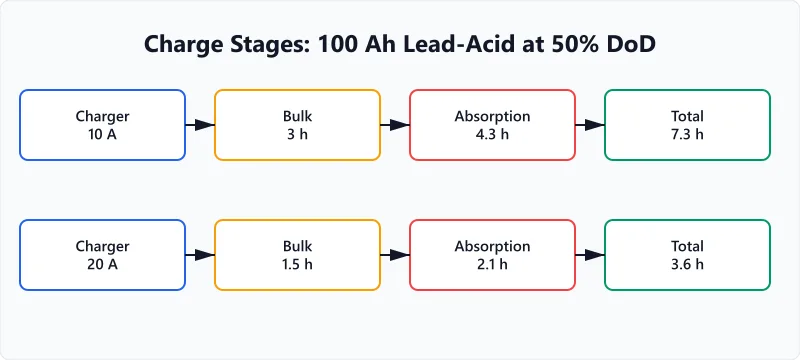
A charger does not push its full current for the whole charge. The site's battery charge time calculator models two stages and reports each one: bulk puts amps in at full current up to about 80% state of charge on lead-acid and 95% on LiFePO4, then absorption holds the voltage while the current falls away. A 100 Ah lead-acid battery at 50% depth of discharge on a 10 A charger takes 7.3 hours: 3 hours of bulk and 4.3 hours of absorption. On a 20 A charger the same job takes 3.6 hours: 1.5 hours of bulk and 2.1 hours of absorption, so in the calculator both stages shorten as the charger gets bigger. Those hours are the calculator's model of how long the cells take to accept the charge at each current. Your charger's own program sets how long a real charge takes: a charger that follows Victron's clock for its lithium battery holds absorption longer than the model does, and one set to Trojan's printed maximum absorption time can end absorption sooner, as the next two paragraphs set out.
Apart from its 0.5C recommendation, Victron's manual lists a charging clock for its lithium battery: after starting the charger, it takes two hours to reach absorption voltage; another two hours of absorption follow; and at the end of the absorption time the charging voltage drops to 13.5 V float. Of those two periods, only the first depends on the charger's current. The second does not change with the current, because Victron recommends a fixed absorption period of 2 hours for lithium batteries so that there is enough time for cell balancing to take place. The 2 hours of the 0.5C recommendation is the battery's capacity divided by the current, 100 Ah at 50 A. The absorption hours hold the voltage for the balancer and put little energy in, which is why the whole clock runs longer than that.
Trojan puts a maximum on the absorption phase instead. Trojan's maintenance page prints a maximum absorption phase time of 2 hours for the AGM line and 4 hours for the Solar Premium and Signature lines, and a finish current of 1% to 3% of C20 for Solar Premium and Signature, with none printed for AGM.
Two Batteries Run Through the Calculators
The Lead-Acid Battery
Take the same 100 Ah lead-acid battery at 50% depth of discharge. In the battery charge time calculator it charges in 7.3 hours on a 10 A charger and in 5.6 hours on a 13 A charger, the two ends of the selection rate above. A 20 A charger, double the 10 A, brings it to 3.6 hours. The 100 Ah charge time calculator prints the same 7.3 hours at its default 10 A and 50% depth of discharge.
On a Trojan battery rated 100 Ah, a charger above 13 A goes past both Trojan's 10% to 13% selection rate and the 13% maximum of its Solar Premium and Signature lines. For a Trojan AGM battery with a C20 rating of 100 Ah, the 20% maximum works out to 20 A, the current of the 20 A run above.
The LiFePO4 Battery
Now a 100 Ah LiFePO4 battery at 80% depth of discharge. In the battery charge time calculator's model, a 50 A charger, 0.5C on this battery, takes 1.6 hours, with 0.1 hours of that in absorption. The calculator counts bulk until the cells reach the LiFePO4 bulk-end state of charge given under Bulk and Absorption, then counts the rest of the charge as absorption. On a Victron battery the clock in that section applies: a charger that keeps to it holds absorption voltage for the balancing time, far longer than the calculator's absorption. A 20 A charger takes 4 hours, with 0.3 hours in absorption. The 100 Ah charge time calculator prints the same 4 hours at 20 A and 80% depth of discharge. For how the two chemistries compare on runtime, see the LiFePO4 vs lead-acid runtime comparison.
What That Means for the Purchase
On both batteries the calculator's charge time falls roughly in step with the charger's amps: double the current on the lead-acid battery and 7.3 hours becomes 3.6, and 2.5 times the current on the LiFePO4 battery takes 4 hours to 1.6. Start the purchase from the rating the steps above give you: the battery maker's rate times your capacity. Run the calculator at that current to see how long the charge takes. Take the finishing clock from the charger's own manual. If no charger is sold at that rating, the nearest one above it is allowed only where it stays at or under the maker's maximum, and it charges faster. Where the maker's rate already reaches its maximum, as Trojan's 13% does on its Solar Premium and Signature lines in the lead-acid section above, take the nearest one below, which charges slower. The calculator's hours are estimates from its two-stage model.
When the Charger Is a Solar Array
A solar charge controller is a charger fed by panels, and the same settings apply to it. Battle Born's manual for its 100 Ah 12 V battery asks you to verify that any charging component in your system, such as converters, inverter chargers, solar charge controllers or DC-to-DC chargers, can be programmed to its specifications. What changes on solar is the current, which the array and the weather set.
The solar battery charge time calculator works in days instead of hours. At its defaults, a 400 W array with 5 peak sun hours, 14% system losses and 92% charge efficiency charges a 200 Ah 12 V LiFePO4 battery from 80% depth of discharge in about 1.4 days. The calculator divides the 2048 Wh to replenish, counted at the LiFePO4 bank's 12.8 V nominal rather than the 12 V label, by the charge efficiency first, then by the day's 1591 Wh of solar: the array's watts times the sun hours, less the system losses, the charge controller's loss and the panels' loss at working temperature. Its note says the estimate assumes every day brings the peak sun hours you entered, and to allow more time where the weather varies. If you need the battery full sooner, add array wattage or a second charging source and run the calculator again.
Cold, Heat and the Lithium Charge Window
A charger with a lithium profile still cannot charge a lithium battery outside its temperature window. Victron's manual gives the range over which its battery can be charged as 5 °C to 50 °C, and says charging outside it "may cause severe damage to the battery or reduce battery life expectancy". Victron's BMS turns chargers off on a low battery temperature alarm, and on a high one.
Battle Born's manual says its BMS will not allow a charging current under 32 °F (0 °C), and will not allow one if the battery's internal temperature exceeds 131 °F (55 °C).
On both makers' batteries the BMS blocks the charge below the low limit and above the high one. A charger's current does not move either limit, so warm or cool the battery into its window before you charge it.
Settings the Charger Has to Match
The charger's settings have to match the battery as well as its current. For its 12.8 V models, Victron's manual gives the recommended charging parameters as 14.2 V absorption voltage, 2 hours absorption time and 13.5 V float voltage, and Victron's datasheet prints the charge voltage as between 14 V and 14.4 V, with 14.2 V recommended. Victron recommends a minimum absorption time of 2 hours per month for lightly cycled systems, and where a charger has a bulk voltage setting, Victron says to set it to the same value as the absorption voltage.
Battle Born's manual notes that not all chargers support multi-stage charging. If yours does not, Battle Born says to make sure it can be programmed for the bulk/absorption voltage and that features like equalization and temperature compensation are disabled.
Trojan's lines ask for different settings. Trojan recommends a three-stage charger, and its maintenance page prints, per cell, an absorption voltage of 2.40 V and a float voltage of 2.25 V for the AGM line, and an absorption voltage of 2.45 V, a float voltage of 2.25 V and an equalization voltage of 2.70 V for the Solar Premium and Signature lines. For the AGM line the page prints a temperature compensation figure and no equalization voltage. Read Trojan's voltages per cell as printed and multiply by the cells in your battery. Where the charger has a bulk voltage setting rather than a current, Trojan says to use the absorption settings in it.
Trojan's FAQ page says equalizing should be performed when a battery is first purchased, also called a freshening charge, and on a regular basis or as needed. A charger for Trojan's Solar Premium and Signature lines needs an equalize mode you can run.
Frequently Asked Questions
Written and maintained by Dan Dadovic, Commercial Director at Ezoic Inc. & PhD Candidate in Information Sciences. He works professionally as Commercial Director at Ezoic Inc., leading revenue strategy across digital publishing.
Disclaimer: Calculator results are estimates based on theoretical formulas. Actual performance varies with temperature, battery age, load patterns, and equipment condition. For critical electrical work, consult a licensed electrician.
Methodology reviewed by Doc. dr. sc. Damir Topić, Assistant Professor, FERIT Osijek.