Cold Cranking Amps: How Many CCA Does Your Engine Need?
Last updated:
8 min read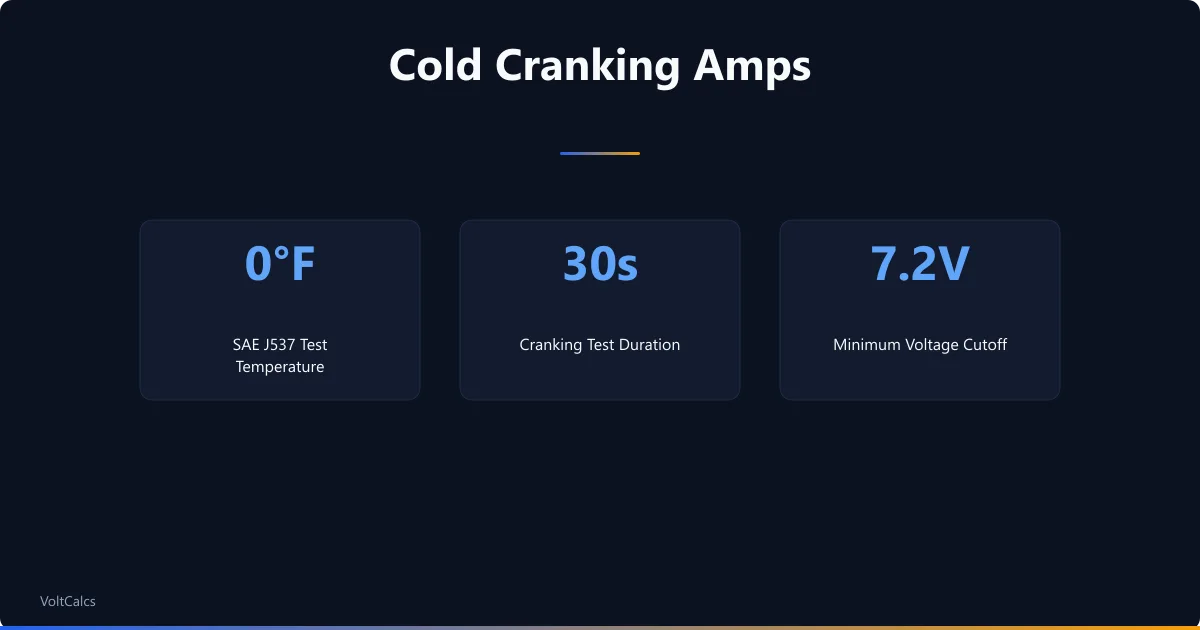
Cold cranking amps (CCA) is the number of amps a 12-volt battery delivers for 30 seconds at 0°F (−18°C) while staying above 7.2 volts. Our fit to published original-equipment fitment data puts a gasoline engine at 438 + 46 CCA per litre and a diesel at 326 + 158, so a 5.0-litre V8 asks for 668 CCA before any cold-weather margin. Your owner's manual or the original battery label still gives the figure that actually matters.
CCA is the most important spec on a starting battery, and the most misread. Manufacturers stamp a wall of three-letter ratings on the case (CCA, CA, MCA, HCA, RC), and swapping one for another is how people end up with a battery that turns over fine in the shop and clicks dead on the first hard frost. This guide explains what CCA measures, how it differs from the ratings printed next to it, how many you actually need, and the one situation where the number means nothing. To turn your engine size and fuel type straight into a target figure, run them through our CCA requirement calculator; this guide is the reasoning behind it.
What Cold Cranking Amps Actually Measure
CCA comes from a single standardized bench test, SAE J537. The battery is chilled to 0°F (−18°C), held there, then forced to deliver a constant current for 30 seconds. If it stays above 7.2 volts (1.2 volts per cell) for the full 30 seconds at a given current, that current is its CCA rating. A 600 CCA battery, by definition, pours out 600 amps for half a minute at 0°F without sagging below 7.2 volts.
The test recreates the worst moment a starting battery faces: a freezing morning, thick oil, an engine that has not run all night. Cranking is a short, violent draw: a starter pulls hundreds of amps in a short burst, then the engine catches and the demand vanishes. That is a different job from running a fridge or a trolling motor for hours, which is why a starting battery and a deep-cycle battery are built differently inside. The closest parallel sits in the motor world: the surge an electric motor pulls the instant it starts, the subject of our locked rotor amps explainer. In both cases the number that counts is the brief peak the source must deliver on demand, not the steady load it carries afterward.
CCA, CA, MCA, HCA, and RC: Reading the Rating Soup
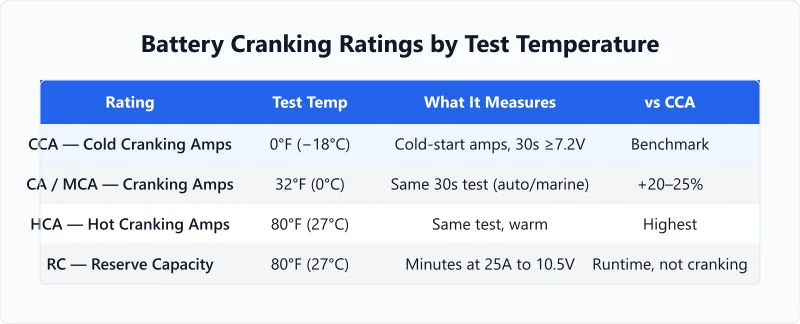
Five ratings crowd a battery case, and they are not interchangeable. The four cranking ratings (CCA, CA, MCA, and HCA) measure the same thing, amps for 30 seconds to a 7.2-volt cutoff, but at different temperatures, so the same battery scores higher as the test gets warmer. Two of those four, CA and MCA, run the identical test at 32°F (0°C) under different names: CA is the automotive label and MCA the marine one, so a battery's CA and MCA figures are effectively the same number. Reserve capacity is a different animal: it measures runtime, not cranking.
| Rating | Full name | Test temperature | What it measures |
|---|---|---|---|
| CCA | Cold Cranking Amps | 0°F (−18°C) | Amps for 30s above 7.2V (the cold-start benchmark) |
| CA / MCA (same test) | Cranking Amps / Marine Cranking Amps | 32°F (0°C) | Same 30s test, milder temp; about 20–25% higher than CCA |
| HCA | Hot Cranking Amps | 80°F (27°C) | Same 30s test, warm; the most flattering number |
| RC | Reserve Capacity | 80°F (27°C) | Minutes at 25A before dropping to 10.5V (runtime, not cranking) |
The trap is comparing across ratings. Because a battery tested at 32°F looks stronger than the same battery tested at 0°F, a marine battery advertised at 750 MCA is weaker in the cold than a car battery rated 750 CCA. The marine number was earned in milder conditions. Always line up CCA against CCA. If a battery only quotes CA or MCA, expect its true cold-start figure to be roughly 17–20% lower. Reserve capacity, quoted in minutes, answers a question CCA cannot: how long the battery keeps the lights and pumps alive if the alternator quits. To turn that figure into amp-hours, our reserve-capacity-to-amp-hours converter gives both the charge the 25-amp test actually delivers and an estimate of the 20-hour rating a deep-cycle label prints.
How Many Cold Cranking Amps Do You Need?
Publishers such as Battle Born print a workshop rule of thumb: about one amp per cubic inch of displacement, doubled for diesel because high compression makes the starter work far harder. Read it as a floor rather than an answer. For a 305 cubic inch (5.0-litre) V8 the rule gives 305 CCA, well under the 668 CCA that original-equipment fitment data asks for at that size.
Our calculator takes a different route to the same question. It is a least-squares fit to the original-equipment minimum CCA ratings Battery Council International publishes for cars and light trucks, as reprinted in the 2011 Cat Batteries Cross Reference Guide. Gasoline comes out at 438 + 46 CCA per litre across 3,197 fitments and diesel at 326 + 158 across 131, with two-battery trucks counted as one combined figure. The guide's gasoline rows span 0.8 to 8.4 litres and its diesel rows 1.6 to 7.3, so anything outside those sizes is extrapolated.
Engine size and compression are what move the figure most: a 6.7-litre diesel asks for 1,385 CCA against 512 for a 1.6-litre economy car, 2.7 times as much, though the diesel figure covers both of the batteries such a truck carries. Cold pushes it up too, and the guide behind these figures says so directly: a driver in extreme weather, or a vehicle with many electrical options, should be sold a battery with more cold cranking amps than the listed minimum, because more will not harm the vehicle while fewer may fail early. It prints no uplift figure, and neither does the calculator: no battery maker or standards body we could find publishes one. Modern engines with efficient starters and electronic fuel injection often start on less than any formula suggests, which is why the manufacturer's recommendation beats all of them.
That recommendation lives in two places: your owner's manual, and the label on the battery that came with the vehicle. Match or exceed that figure: a replacement with more cold cranking amps than the maker's minimum does no harm, while one with fewer may fail to start the engine in cold weather. For a number tuned to your exact engine size and fuel type, the calculator linked above does the arithmetic in one step.
Worked Example: From Engine to Battery Label
Take a 5.0-litre V8 gasoline truck, about 305 cubic inches, kept in Minnesota where January nights reach −20°F. Work it through the calculator's rule step by step, with the workshop rule alongside for comparison.
Minimum. 438 + (5.0 × 46) = 668 CCA. One amp per cubic inch would have said 305, so the fitment data asks for more than twice what the shortcut suggests.
Spread. The guide prints minimums for 878 petrol fitments between 4.1 and 6.0 litres, and half of them sit between 600 and 760 CCA. Run the same engine through the calculator and it prints both the 668 and that band.
Margin. A battery loses cranking power every year it ages, and a Minnesota January asks more of it than the bench test does. Buy from the upper part of that printed band rather than at the 668 figure, and the truck still starts in the battery's fourth winter.
Now read the label. A Group 65 battery stamped 750 CCA / 900 MCA / 110 min RC clears the 668 CCA minimum and sits near the top of the 600-760 CCA band the guide prints for engines this size. The 900 figure is MCA, tested at 32°F, so ignore it for cold-start comparison and judge the battery on its 750 CCA. The 110-minute reserve capacity is a bonus that tells you how long the truck's accessories last if the charging system fails, but it says nothing about whether the engine turns over at −20°F.
Why Cold Weather Hits Starting Twice
Cold attacks a cold start from both sides at once. Inside the battery, the chemical reactions that produce current slow as temperature falls; at 0°F a typical lead-acid battery delivers only about 60–70% of its rated capacity, and the figure keeps dropping as it gets colder. At the same moment, the engine is harder to turn: motor oil thickens in the cold, so the starter fights more drag to spin the crankshaft. The battery offers less just as the engine demands more.
That double squeeze is the whole reason cold climates need oversized CCA. Chemistry matters here too: lithium and lead-acid behave very differently in the cold, a gap we cover in our LiFePO4 versus lead-acid comparison. For a lead-acid starting battery the practical takeaway is blunt: buy more CCA than the calculator's bare minimum if you park outside through hard winters, because the rating you read on a warm shelf is not the power you get on the coldest morning of the year.
When CCA Doesn't Matter: Lithium House Banks
CCA only describes a battery built to start an engine. A deep-cycle battery (the kind that runs an RV fridge, a trolling motor, or an off-grid cabin) is rated in amp-hours, not cranking amps, because its job is steady output over hours rather than a violent burst over seconds. If the steady load you are sizing for is a trolling motor, our trolling motor runtime estimator works in those amp-hours and in the depth of discharge you are willing to reach. Lithium (LiFePO4) house batteries typically carry no CCA rating at all, because they are designed for energy storage, not engine cranking. Asking for the CCA of a 100Ah LiFePO4 house bank is like asking for the towing capacity of a bicycle: the wrong question for that product.
For storage batteries the number that matters is capacity. To see how amp-hours translate into hours of runtime for your loads, use our amp-hour capacity calculator; to gauge how long a starting battery itself can run accessories with the engine off (radio, dome light, a phone charger), our car battery runtime calculator covers that key-off math. The two specs answer two questions: CCA tells you whether the engine starts, while amp-hours and reserve capacity tell you how long the battery lasts once it is the only thing running.
Read CCA the way the standard intends: the cold-morning current a starting battery can deliver, measured at 0°F, and meaningless for a deep-cycle bank. Match your engine and climate to a sensible target, compare batteries CCA-to-CCA rather than against a flattering MCA or CA number, and leave yourself margin for the years the battery will age in your vehicle. Get those three right and the coldest morning of the winter becomes a non-event. These figures are typical guidelines; a specific vehicle's requirement depends on its starter, wiring, and how cold it actually gets, so the manufacturer's recommendation is always the final word.
Frequently Asked Questions
Written and maintained by Dan Dadovic, Commercial Director at Ezoic Inc. & PhD Candidate in Information Sciences. On the energy side, Dan has hands-on experience with residential solar panel installation, DIY battery bank construction, off-grid power systems, wind power, and EV ownership/driving, all from building, maintaining, and operating his own systems.
Disclaimer: Calculator results are estimates based on theoretical formulas. Actual performance varies with temperature, battery age, load patterns, and equipment condition. For critical electrical work, consult a licensed electrician.
Methodology reviewed by Doc. dr. sc. Damir Topić, Assistant Professor, FERIT Osijek.