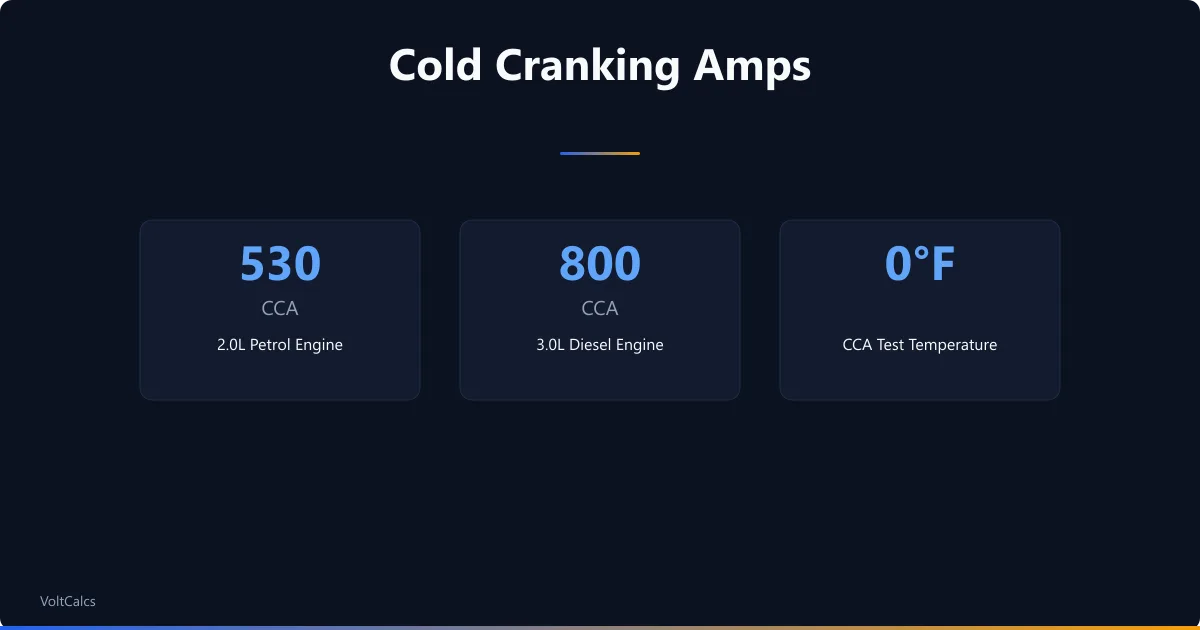
Minimum CCA by Engine Size and Fuel
Read this as a floor, not a forecast. Each fitted figure is the minimum the calculator returns at the two ends of that displacement band. Beside it sits the middle half of the minimums the source itself prints for engines that size, so you can see how wide the real spread is. The petrol figure is one battery; the diesel figure is a whole-vehicle total, so on a truck that carries two batteries the pair shares it — the 1,385 CCA a 6.7L diesel asks for works out at roughly 693 CCA from each.
| Engine size | Petrol minimum | Printed middle half | Diesel minimum | Printed middle half |
|---|---|---|---|---|
| 0.8-1.5L (city car) | 475-507 CCA | 368-435 CCA (84 fitments) | — | no diesel this small in the guide |
| 1.6-2.5L (sedan) | 512-553 CCA | 460-590 CCA (951 fitments) | 579-721 CCA | 574-650 CCA (24 systems) |
| 2.6-4.0L (SUV/truck) | 558-622 CCA | 540-660 CCA (1,135 fitments) | 737-958 CCA | 825-850 CCA (20 systems) |
| 4.1-6.0L (large truck) | 627-714 CCA | 600-760 CCA (878 fitments) | 974-1,274 CCA | 1,450-1,500 CCA (12 systems) |
| 6.1-8.4L (heavy duty) | 719-824 CCA | 600-750 CCA (149 fitments) | 1,290-1,479 CCA | 1,170-1,500 CCA (75 systems) |
Where the two columns disagree, believe the printed one. At the small end the fitted petrol line sits above the middle half, because a straight line through a population whose CCA climbs fast and then flattens over-predicts at both ends. In the 4.1-6.0L diesel band the line sits well below, because almost every diesel that size in the guide is a two-battery truck at 1,500 CCA combined. Below 1.0L the petrol and diesel lines meet, and the guide lists no diesel under 1.6L at all, so a small diesel returns the petrol figure and the calculator says so on the result.
These figures are our own least-squares fit to the original-equipment minimum CCA ratings that Battery Council International publishes for cars and light trucks, as reprinted in the 2011 Cat Batteries Cross Reference Guide: petrol 438 + 46 × litres across 3,197 fitments, diesel 326 + 158 × litres across 131 systems, with two-battery trucks counted as one combined figure. The middle-half columns are the 25th and 75th percentile of the same rows. The guide's petrol rows span 0.8 to 8.4L and its diesel rows 1.6 to 7.3L, which is why the calculator stops there. Check your result against your owner's manual or the original battery label before buying.
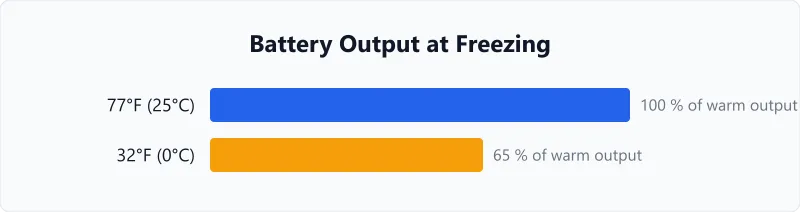
When to Buy Above the Minimum
The figures above are minimums, and the guide behind them says so in as many words: the cold cranking ratings it lists "are the minimum recommendation for each application", with "no warranty level or battery life expectancy expressed or implied by these ratings". Its counter-staff guidance goes further. If a customer drives in extreme weather, or runs a vehicle with many electrical options, the guide tells the seller to suggest a battery with more cold cranking amps than the listed minimum: more will not harm the vehicle, fewer may fail early. It repeats the point in its maintenance section, where vehicles worked in extremely cold climates are told to carry a battery rated well above the original-equipment recommendation.
Three things push a real vehicle above its printed minimum:
- Cold. Cold robs a battery of cranking power and stiffens the motor oil the starter has to turn, so the battery gives less at the moment the engine asks for more. The guide states the effect and gives no uplift figure, and neither does this calculator: no battery maker or standards body we could find publishes one, so putting a number here would be inventing it.
- Accessories. Winches, inverters, radios, aftermarket lighting and a long idle at the kerb all draw from the same battery that has to crank the engine afterwards.
- Age. A battery gives its full rated CCA when it is new and fully charged, and less every year after that as the plates wear and sulfate. A battery bought at the bare minimum has no margin left by the time it meets a hard frost in its third or fourth winter.
None of that has a printed multiplier, so treat it the way the guide does: as a reason to choose from the upper part of the printed spread rather than the lower. The cheapest margin on the whole job is buying one step up the range while the battery is new.
Worked Examples
Battery for a 6.7L Diesel Pickup
Context
You run a 6.7L diesel pickup that carries two batteries under the bonnet. You want to know what the original-equipment data asks for before you price a pair.
Calculation
Minimum CCA for a 6.7L diesel: 326 + (6.7 × 158) = 1,384.6, rounded to 1,385 CCA
This is the whole-vehicle figure: about 693 CCA from each of the two batteries.
Printed spread for diesels between 6.1 and 7.3L: half of the 75 systems in the guide sit between 1,170 and 1,500 CCA combined.
Interpretation
1,385 CCA sits inside the printed middle half, toward the upper end. Ford’s own specification sheet for the 2025 F-Series Super Duty lists this engine as "6.7-liter, dual 12-volt; 750-CCA/68-amp-hr AGM", which is 1,500 CCA combined — at the top of that same printed band, and above the fitted figure. Buy a pair at 750 CCA each and you match what Ford fits; a pair at 693 each meets the fitted minimum and nothing more, which is thin margin for a truck that has to start after a night outside.
Takeaway
CCA only measures starting ability. If you also run accessories with the engine off, check how long the battery lasts with our deep cycle runtime calculator to avoid getting stranded.
Minimum CCA for a 4-Cylinder Economy Car
Context
Your 1.6L petrol sedan needs a new battery. You want the smallest one that will not leave you turning a dead key, without paying for cranking power the car cannot use.
Calculation
Minimum CCA for a 1.6L petrol engine: 438 + (1.6 × 46) = 511.6, rounded to 512 CCA
Printed spread for petrol engines between 1.6 and 2.5L: half of the 951 fitments in the guide sit between 460 and 590 CCA.
Interpretation
512 CCA lands squarely inside the printed middle half, which is the useful reading here: cars this size are fitted with anything from the high 300s to the mid 800s, and 512 is an ordinary figure among them rather than a hard threshold. A Group 35 battery covers that range, so almost any Group 35 clears the fitted minimum. Pick from the upper part of the printed spread, nearer 590 than 460, and the car still starts in the battery’s fourth winter.
Takeaway
Excess CCA is not wasted — it provides margin as the battery ages. To understand how CCA relates to amp-hours for accessory use, see our battery capacity calculator.
Frequently Asked Questions
Glossary
Cold Cranking Amps
The current a 12V battery can deliver for 30 seconds at 0°F (−18°C) while maintaining at least 7.2V. It is the industry standard for comparing starting battery performance in cold conditions.
Cranking Amps
Similar to CCA but tested at 32°F (0°C) instead of 0°F. CA numbers are always higher than CCA for the same battery. Some manufacturers advertise CA instead of CCA to make batteries appear more powerful.
Engine Displacement
The total volume swept by all pistons in the engine, measured in liters. Larger displacement requires more energy to crank because there is more air to compress. Diesel engines need even more because they compress their air charge far harder, which makes the starter work against a stiffer engine.
Converting between battery specs? Try the reserve capacity to amp hours converter to compare RC and Ah ratings.
Related calculators
Car Battery Runtime Calculator
Calculate how long a car battery powers accessories with the engine off. Know the limits before you drain your starter.
Battery
Reserve Capacity to Amp Hours
Convert battery reserve capacity minutes into amp-hours two ways: the exact capacity at the 25 amp test rate and an estimated 20-hour rating.
Battery
Locked Rotor Amps (LRA) Calculator
Calculate motor locked rotor amps (LRA) for starting current estimation. Enter FLA and multiplier based on NEMA code letter.
Electrical
Battery Voltage to Percentage Calculator
Turn a resting multimeter reading into a state of charge percentage for flooded lead-acid and AGM batteries, from the makers' own printed voltage tables.
Battery
Buy more CCA than the minimum — battery capacity degrades every year, and the coldest morning of the winter is not the day you want to discover your battery is marginal. Check your current battery's CCA rating against the values above, and replace it before it fails. If you are considering a LiFePO4 starting battery, note that cold-weather cranking performance differs between chemistries — our LiFePO4 vs lead-acid comparison covers the trade-offs.
More Battery calculators
Browse all battery calculators — LiFePO4, lead-acid, AGM, and lithium-ion runtime, charge time, and capacity sizing.
Last updated:
Written and maintained by Dan Dadovic, Commercial Director at Ezoic Inc. & PhD Candidate in Information Sciences. He works professionally as Commercial Director at Ezoic Inc., leading revenue strategy across digital publishing.
Disclaimer: Calculator results are estimates based on theoretical formulas. Actual performance varies with temperature, battery age, load patterns, and equipment condition. For critical electrical work, consult a licensed electrician.
Methodology reviewed by Doc. dr. sc. Damir Topić, Assistant Professor, FERIT Osijek.