How to Size a Breaker in Three Steps
Start with the load, not the breaker. The calculator follows the same three steps an electrician uses, all from the National Electrical Code:
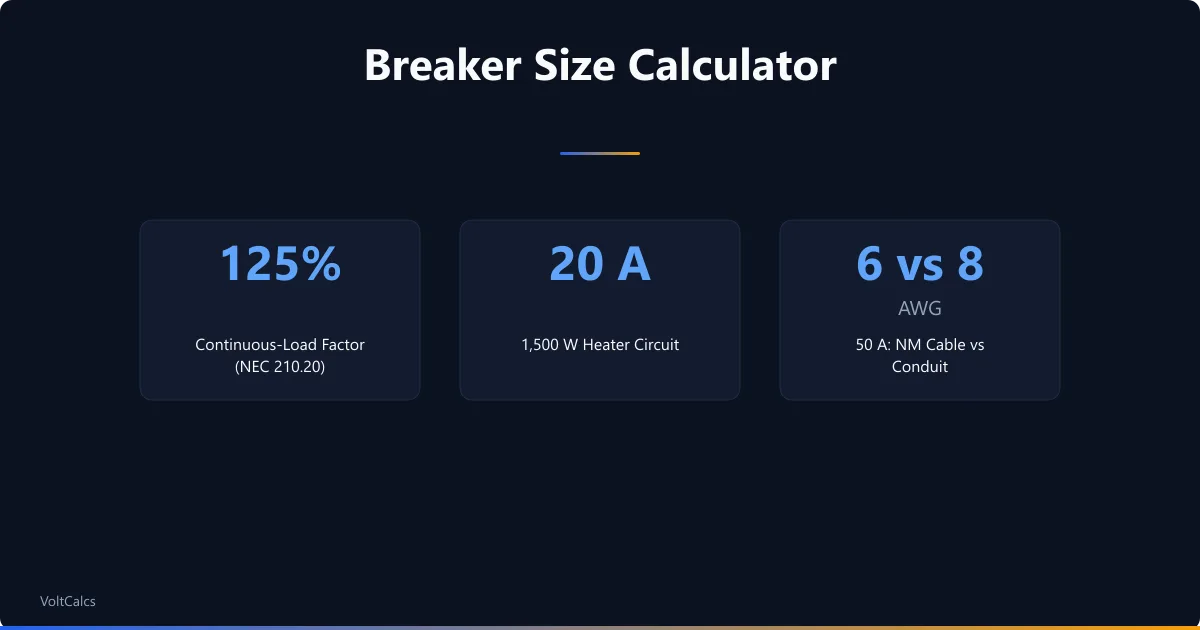
- Find the load current in amps. Read it off the nameplate, or convert watts to amps (watts ÷ volts). A 1,500 W heater on 120 V draws 12.5 A.
- Apply the 125% rule if the load is continuous. A load that runs three hours or more is sized at 125% per NEC 210.20(A), so 12.5 A becomes 15.6 A.
- Round up to the next standard breaker, then match the wire. NEC 240.6(A) lists the standard sizes (15, 20, 30, 40, 50 A and up), so 15.6 A rounds up to a 20 A breaker on 12 AWG copper.
The breaker protects the wire, so the conductor always comes from the breaker rating, never from the load directly. The next two sections show the exact wire pairings and why continuous loads change the answer.
Breaker Size to Copper Wire Size
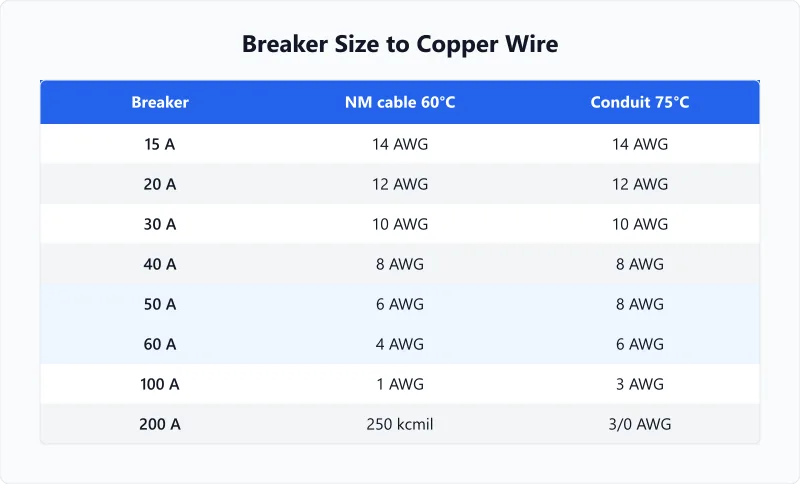
Once you know the breaker, the minimum copper wire follows from NEC Table 310.16 — but with a catch. NM-B cable (the Romex in most homes) is limited to the lower 60 °C ampacity column by NEC 334.80, while THHN/THWN conductors in conduit can use the 75 °C column when the terminations are rated for it. Cited to NEC 334.80. The code text itself is not freely available to link; confirm the figure against the current edition or your authority having jurisdiction before acting. The two diverge at 50 A and above, so the table gives both:
| Breaker | NM-B cable (60 °C) | THHN in conduit (75 °C) |
|---|---|---|
| 15 A | 14 AWG | 14 AWG |
| 20 A | 12 AWG | 12 AWG |
| 30 A | 10 AWG | 10 AWG |
| 40 A | 8 AWG | 8 AWG |
| 50 A | 6 AWG | 8 AWG |
| 60 A | 4 AWG | 6 AWG |
| 70 A | 4 AWG | 4 AWG |
| 80 A | 3 AWG | 4 AWG |
| 90 A | 2 AWG | 3 AWG |
| 100 A | 1 AWG | 3 AWG |
| 110 A | 1 AWG | 2 AWG |
| 125 A | 1/0 AWG | 1 AWG |
| 150 A | 3/0 AWG | 1/0 AWG |
| 175 A | 4/0 AWG | 2/0 AWG |
| 200 A | 250 kcmil* | 3/0 AWG |
*Past 4/0 AWG, NM cable is no longer practical: large feeders and services use THHN or SER and should be sized by an electrician. A long run can also force a thicker wire to hold voltage drop in check, which our guide to voltage drop explains. These figures assume copper, no more than three current-carrying conductors, and a 30 °C ambient.
Why Continuous Loads Need a Bigger Breaker
A breaker cannot carry its full rating around the clock. NEC 210.20(A) requires it to be rated for 125% of a continuous load, which is the same as saying a standard breaker only carries 80% of its rating for anything that runs three hours or more. That is why a 1,500 W heater at 12.5 A needs a 20 A breaker, not a 15 A one: 12 A is all a 15 A breaker will hold continuously. Cited to NEC 210.20(A). The code text itself is not freely available to link; confirm the figure against the current edition or your authority having jurisdiction before acting.
| Breaker | Max standard load | Max continuous load (3 hrs+) |
|---|---|---|
| 15 A | 15 A | 12 A |
| 20 A | 20 A | 16 A |
| 30 A | 30 A | 24 A |
| 40 A | 40 A | 32 A |
| 50 A | 50 A | 40 A |
| 60 A | 60 A | 48 A |
| 100 A | 100 A | 80 A |
Set the load type to continuous above and the calculator applies the 125% factor for you. Tallying every circuit for a whole panel or service is a separate job: our electrical load calculator handles dwelling demand by the NEC method.
What This Calculator Does Not Cover
This tool sizes general branch circuits and feeders — receptacles, lighting, heaters, ranges, and similar resistive or mixed loads. It does not size circuits for motors, air conditioners, heat pumps, or welders. Those loads draw a heavy starting surge and follow separate NEC rules: motors size from full-load amps by the percentages in NEC 430.52, and HVAC equipment uses the minimum circuit ampacity (MCA) and maximum overcurrent protection (MOCP) printed on the nameplate. Run a motor load through the general rule and you will undersize its breaker.
Treat every result as a starting estimate, not a wiring permit. The figures assume copper conductors, no more than three current-carrying conductors in a run, and a 30 °C ambient; heat, conduit fill, and bundling all cut ampacity and can push you to a larger wire. Size and install real circuits with a licensed electrician, and confirm everything against the current NEC and your local Authority Having Jurisdiction (AHJ) before energizing.
Worked Examples
Sizing the Circuit for a 1,500 W Space Heater
Context
You are adding a 1,500 W plug-in space heater on a 120 V circuit, and it will run all evening — well over three hours, so it counts as a continuous load. What breaker and wire does it need?
Calculation
Current: 1,500 W ÷ 120 V = 12.5 A
Continuous, so size at 125%: 12.5 A × 1.25 = 15.6 A required
Next standard breaker ≥ 15.6 A: 20 A (a 15 A breaker only allows 12 A continuously)
Wire for a 20 A breaker: 12 AWG copper (both the 60 °C and 75 °C columns)
Interpretation
The heater needs a 20 A circuit with 12 AWG copper, not the 15 A / 14 AWG circuit its 12.5 A draw might suggest — the 125% continuous rule is what bumps it up a size. If you only know an appliance in watts, our amps draw calculator converts watts to amps first.
Takeaway
Any load that runs three hours or more — heaters, EV chargers, pool pumps — gets the 125% treatment, so set the load type before you pick a breaker. Distance is a separate check: a long run can force a thicker wire than the breaker alone calls for.
A 50 A Welder Circuit: NM Cable vs Conduit
Context
A stick welder pulls 50 A and runs in bursts (non-continuous). You will run the circuit from the panel out to the garage. What breaker does it need, and does the wire change if you use Romex versus THHN in conduit?
Calculation
Non-continuous, so no 125% factor: required current = 50 A
Next standard breaker ≥ 50 A: 50 A
NM (Romex) cable, 60 °C column: 6 AWG copper
THHN in conduit, 75 °C column: 8 AWG copper
Interpretation
Same 50 A breaker either way, but the wire depends on the method: 6 AWG for Romex, 8 AWG for THHN in conduit. NM cable is held to the lower 60 °C ampacity by NEC 334.80, so it needs the thicker conductor. When in doubt, run the heavier 6 AWG.
Takeaway
The breaker protects the wire, so the wire must match the breaker and the wiring method, never the other way around. Motor-driven tools are the exception: a welder is a steady load, but an actual motor circuit sizes by NEC 430.52, not this rule.
Frequently Asked Questions
Glossary
Overcurrent Protective Device (OCPD)
The breaker or fuse that opens a circuit when current exceeds its rating. NEC 240.6(A) lists the standard breaker sizes — 15, 20, 30, 40, 50, 60 A and up — and you always round up to the next standard size, never down. The OCPD exists to protect the wire, so its rating is tied to the conductor ampacity, not to the appliance plugged in.
Continuous Load
A load where the maximum current is expected to continue for three hours or more, per NEC Article 100. Continuous loads must be sized at 125% on both the breaker (210.20(A)) and the conductor (210.19(A)(1)). Electric heat, EV charging, and store lighting are continuous; a microwave or a hair dryer is not.
Ampacity
The maximum current a conductor can carry continuously without exceeding its temperature rating, from NEC Table 310.16. The same copper wire has different ampacities in the 60 °C, 75 °C, and 90 °C columns; the column you use depends on the cable type and the equipment terminations. For breaker sizing, the conductor ampacity must be at least the breaker rating.
Small-Conductor Rule (NEC 240.4(D))
A code limit that caps the breaker on the thinnest conductors regardless of their table ampacity: 14 AWG copper at 15 A, 12 AWG at 20 A, and 10 AWG at 30 A. It exists because thin wires heat up fast under a fault. This is why 12 AWG is never placed on a 25 A breaker even though its 75 °C ampacity is 25 A.
Wiring an off-grid system instead of a grid circuit? The inverter and battery side has its own overcurrent protection, and our battery size for inverter calculator helps you spec the bank that feeds it.
Related calculators
Amps Draw Calculator
Calculate current draw in amps from watts and volts for any device. Supports single-phase and three-phase loads with power factor adjustment.
Electrical
Wire Distance Calculator
Calculate voltage drop and recommended wire gauge for any distance. Enter amps, distance, voltage, and target drop percentage.
Electrical
Electrical Load Calculator
Calculate your home's electrical load and NEC 220 demand for panel and service sizing. Enter loads and quantities for connected and demand estimates.
Electrical
Motor FLA Calculator
Calculate motor full load amps for single-phase and three-phase motors. Enter HP, voltage, efficiency, and power factor for instant FLA results.
Electrical
Two numbers decide a safe circuit: the breaker that protects the wire, and the wire that can carry the breaker. Get them in that order — size the breaker to the load, then size the wire to the breaker, never the reverse. The most common and most dangerous shortcut is swapping a tripping breaker for a bigger one without upsizing the wire, which strips out the very protection the breaker exists to provide. When the load is a motor, an air conditioner, or anything with a large startup surge, stop here and size it from the equipment nameplate or with a licensed electrician instead.
More Electrical calculators
Browse all electrical calculators — Motor FLA, wire sizing, voltage drop, load calculations, and transformer fusing based on NEC standards.
Last updated:
Written and maintained by Dan Dadovic, Commercial Director at Ezoic Inc. & PhD Candidate in Information Sciences. He works professionally as Commercial Director at Ezoic Inc., leading revenue strategy across digital publishing.
Disclaimer: Calculator results are estimates based on theoretical formulas. Actual performance varies with temperature, battery age, load patterns, and equipment condition. For critical electrical work, consult a licensed electrician.
Methodology reviewed by Doc. dr. sc. Danijel Jerković-Štil, Assistant Professor, FERIT Osijek.